 Bisrat Shibeshi
No. There's no published study behind the claim that applicant tracking systems reject 75% of resumes. The number traces back to a 2012 article quoting the founder of Preptel, a company that sold software for checking resumes against job postings, and the article gave no method or data for it.
What an ATS does with your application is documented by the companies that make them. Automatic rejections come from rules the employer sets, mostly screening questions. Formatting problems give a recruiter a half-filled candidate profile that someone has to correct by hand. Newer AI features grade and sort applicants, which affects who gets read first.
This piece traces the 75% figure, shows what Greenhouse, SAP, Workday and Oracle say their software does, and ends with what's worth fixing in your own application.
Where does the "75% of resumes are rejected" claim come from?
The earliest version we found is a post dated April 2, 2012 on Preptel's website, preserved by the Wayback Machine. Under "Did you know?", it says at least 75 percent of resumes "are discarded for using the wrong words" and that more than 20 percent fail because of formatting. The post then credits the statistics to Jonathan Ciampi, Preptel's president and founder.
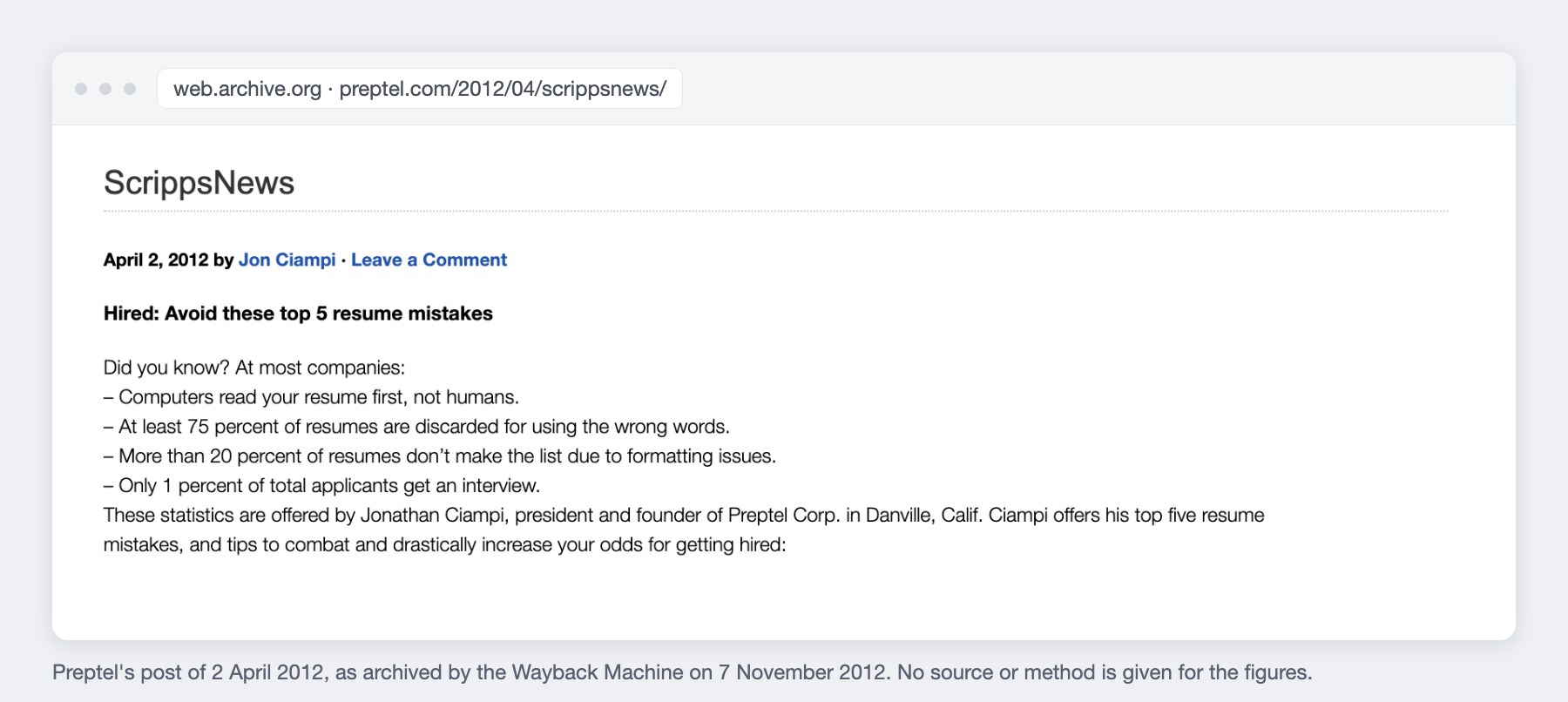
Preptel sold Resumeter, a product for checking whether a resume used the right words. The post doesn't name a survey, a sample size or a source for either number, so the figure started life as a sales claim from a company selling the fix. It has circulated for more than a decade since, usually without a link back to anything, and we found no study that backs it up.
What does an ATS reject automatically?
Applications get rejected automatically when they break a rule the employer set up. The vendors' own documentation describes the same mechanism.
Greenhouse lets an employer set up auto-reject rules so that, based on an applicant's answer to a question, they're rejected automatically. SAP SuccessFactors moves applicants who fail its prescreening questions into an Auto-Disqualified status. Its help portal also says "There's presently no way to auto-disqualify applicants based on application data" (SAP). The rejecting is done by the questions.
Those rules can be strict. In the Hidden Workers report by Harvard Business School and Accenture, which surveyed 2,275 executives in the US, UK and Germany, 88% agreed that qualified high-skills candidates are vetted out because they don't match the exact criteria in the job description. Almost half of the companies automatically screened out resumes with a gap in work history of more than six months.
A 2022 SHRM survey of 1,688 HR professionals found the same pattern. 64% said their automation or AI tools automatically filter out unqualified applicants, and 19% of organizations using those tools had seen them overlook or exclude qualified people.
So automatic rejection is real. How many people it removes depends entirely on the rules each employer writes, which is why no single percentage can describe it.
Does resume formatting get you rejected by an ATS?
Formatting affects how well your resume is read, which is a different problem. Greenhouse's help center lists what its parser can misread:
- Text with spaces between the letters
- Graphics, photos or word art
- A resume uploaded as an image instead of a document
- Tables, headers and footers
- Your name and contact details in a header, footer or text box
- A columned layout
- Sections without clear headings
It also can't parse files larger than 2.5 MB. Greenhouse says these issues may result in "a partial resume parse that will need to be manually corrected." The application still arrives. What the recruiter sees is a candidate profile with gaps, such as a missing job title, dates in the wrong field or no phone number, until someone fills them in from your file.
That's worth avoiding, because the profile is what recruiters scan and filter on. It's a different risk from an automatic rejection, and a simpler one to fix.
Do ATS systems use AI to rank resumes?
Some do, and they publish how. Workday's bias audit disclosure describes HiredScore Spotlight grading candidates against job requirements on an A, B, C, D scale. Oracle Recruiting's Job Application AI Rating uses generative AI to rate a candidate's education, experience, skills and profile from 0 to 5 when a recruiter runs it. Greenhouse's Talent Matching sorts candidates by how well they match, and its FAQ says it "does not auto-reject or auto-advance any candidate."
A low grade doesn't remove you from the list. On a role with hundreds of applicants, though, it affects who gets read first. Recruiters aren't fully sure of these tools either. In a Greenhouse survey from late 2025, only 21% of recruiters and hiring managers were very confident their systems weren't rejecting qualified candidates.
The same survey found that 41% of US job seekers admit to prompt injections, which means hiding text in a resume to sway AI screening. Vendors have noticed. Teamtailor's Co-pilot detects white-on-white text, very small fonts and transparent text, and shows a warning on the candidate's profile.
What should you fix in your own application?
The fixes are a handful of specific checks.
- Answer screening questions accurately and completely. They're the automatic filter every vendor above documents, and a careless answer about work authorization or years of experience can end an application before anyone reads it.
- Use the posting's exact words for requirements you genuinely meet, so a recruiter's filter and your resume describe the same thing. Our guide to tailoring your resume to a job description shows which parts to change.
- Send a PDF or Word file with real, selectable text, under 2.5 MB, with your name and contact details in the body of the page.
- For large employers' application portals, prefer a single-column layout, since column layouts appear on Greenhouse's list of things its parser can misread.
- When an application form offers to fill itself in from your resume, read what it filled in. That's what the parser took from your file, and correcting it there fixes what the recruiter sees.
- Leave out hidden keywords. Some systems now flag hidden text on your profile, which is the opposite of what you want a recruiter to notice.
OneCV's PDFs have selectable text and come in well under 2.5 MB. If you're applying through a big portal, a single-column template such as Classic Clear avoids the layouts Greenhouse warns about. We haven't tested OneCV's PDFs in every ATS, so we don't describe any template as ATS-approved.
Frequently asked questions
Is it true that 75% of resumes are rejected by ATS?
There's no evidence for it. The figure comes from a 2012 article quoting the founder of Preptel, which sold resume-checking software, and the article gave no data behind it. ATS vendors document rejections based on screening questions and other employer rules, and the share they remove varies by employer.
Can an ATS reject my resume without a person seeing it?
Yes, if you fail a rule the employer set up, such as a knockout screening question. Greenhouse and SAP both describe this. SAP's documentation says it can't auto-disqualify applicants based on their application data alone.
Will a two-column resume be rejected by an ATS?
Not for its layout alone. Greenhouse lists columned layouts among the formats its parser can misread, which leaves a partial profile that someone has to correct. A single-column layout is the safer choice for large employers' portals.
Can an ATS read a PDF resume?
Generally, yes. Greenhouse's parser handles documents such as .docx and .pdf files, and its problems come from images uploaded instead of documents, files over 2.5 MB and complex formatting. Make sure your PDF has selectable text, which you can check by trying to select a sentence.
Does putting keywords in white text help?
It's a gamble with a known downside. Teamtailor's Co-pilot detects white-on-white, tiny and transparent text and shows a warning on the candidate's profile.
Do ATS systems use AI to score resumes?
Some do. Workday's HiredScore grades candidates from A to D, Oracle's AI rating scores them from 0 to 5, and Greenhouse's Talent Matching sorts them by match. Greenhouse says its matching doesn't reject or advance anyone automatically.
If you're writing a new resume, create your free OneCV account and start from a single-column template.