 Bisrat Shibeshi

In most of the world, a resume and a CV are the same document. In the UK, Ireland, Europe, much of Africa, the UAE and New Zealand, "CV" is the everyday name for the one- or two-page summary of your work and education that Americans call a resume. The two words mainly mean different documents in the US and Canada, where a resume is the short job document and a CV is a longer academic record used for research, teaching, grant and medical applications.
So the word in the job ad tells you what to call your file, and in North America it also tells you which document to send. The table shows what each country expects, using its own government and university advice where we could find it.
Resume vs CV by country
| Where the job is | Everyday word | Is a CV the same as a resume? | Usual length | Paper size |
|---|---|---|---|---|
| United States | Resume. CV for academic, research and medical jobs | No | Resume one page for students, two at most for federal jobs. Academic CV has no limit | US Letter |
| Canada | Resume. CV for academic and grant applications | No | Resume up to two pages | US Letter |
| United Kingdom | CV | Yes | Two A4 pages at most | A4 |
| Ireland | CV | Yes | Two A4 pages at most | A4 |
| Australia | Both | Mostly, though SEEK disagrees | One to three pages | A4 |
| New Zealand | CV | Yes | Two pages if you can | A4 |
| India | Resume for private and campus jobs. Bio-data or CV on government forms | Government forms treat bio-data and CV as one document | No official limit found | A4 |
| South Africa | CV | Yes | Usually two pages | A4 |
| Kenya | CV | Yes | One to three pages | A4 |
| Nigeria | CV | Yes | One to two pages | A4 |
| Ethiopia | CV | Yes | Up to two pages | A4 |
| UAE | CV | Yes | Two A4 pages at most | A4 |
| Germany, France, Spain, Netherlands | CV | Yes | Two pages | A4 |
Princeton's career office puts the split plainly. In the US, a CV is "an exhaustive academic summary used for applications for roles in academia, scientific research and medical fields", while in "Europe, Ireland and New Zealand, the term CV is used to mean the same as a 'resume' in the U.S." Our CV format guides for Kenya, Nigeria, South Africa, Ethiopia and the UAE cover what employers in each country expect beyond the name.
What is a CV in the US and Canada?
In North America, a CV (curriculum vitae) is the full record of an academic career. MIT's career office says CVs are used "to apply for teaching or research opportunities, fellowships, further academic training, grants" and for tenure and promotion, and that "the term 'resume' is used for industry and other non-academic positions". Canada draws the same line. Dalhousie and the University of Lethbridge describe the CV as the document for academic, research and graduate school applications.
An academic CV adds sections a resume leaves out:
- research experience
- publications, listed in full
- conference talks and posters
- teaching experience
- fellowships, grants and awards
- professional service, such as peer reviewing
- referees, which Oxford says are typical on an academic CV
It also has no page limit. MIT says an academic CV typically runs "2 to 4 pages for a younger professional, 4 to 7 pages for a person with more experience", Harvard says most graduate student CVs are two to five pages, and the University of North Carolina says an experienced professor may have "a 5, 10, or even 20 page CV". Medicine works the same way. The American Medical Association says a medical CV "can run for three or more pages" and adds licensure and certification.
Here's what that looks like for one person. We made a fictional PhD graduate and built both documents in OneCV, at US Letter size.
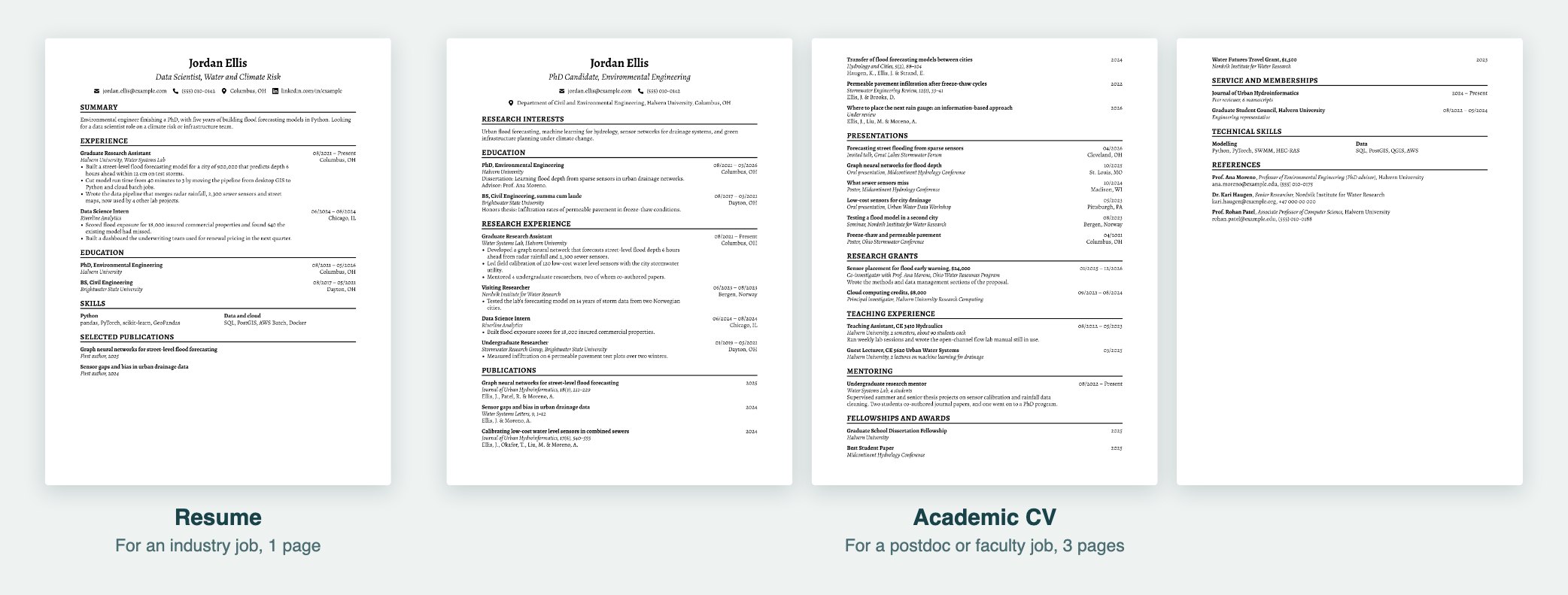
The resume for a data scientist job keeps two publications and turns the research into results an employer can use, such as a model run time cut from 40 minutes to 3. The academic CV for a postdoc keeps every paper, talk, grant and teaching role, and runs to three pages. A hiring manager in industry wants the first. A faculty search committee wants the second.
Research funders often want their own format
Grant applications increasingly replace the free-form academic CV with a fixed template. The US National Science Foundation asks for a biographical sketch built in its SciENcv tool, with up to ten listed research products. UK Research and Innovation uses the Résumé for Research and Innovation, which it calls "a flexible narrative CV template", and Canada's three federal research funders have moved to a narrative tri-agency CV. If a funding call names a format, use it, and keep your own CV for job applications.
What if a US job ad asks for a CV?
Check what kind of job it is. For a faculty, research, postdoc or medical role, send an academic CV. For anything else, the employer most likely means a resume. UC Davis notes that in the US and Canada, "CV and resume are sometimes used interchangeably", and says that if you're not sure which to send, it's best to ask.
Is a UK CV the same as a US resume?
Yes. A UK CV and a US resume do the same job and contain the same sections. Prospects, the UK graduate careers site, says "CV stands for curriculum vitae, a Latin phrase meaning 'course of life'. In other countries, such as the USA and Canada, CVs are known as résumés". Oxford's careers service opens its CV page with "A curriculum vitae (CV), or résumé in North America".
The length rules are close too. In the UK and Ireland, a CV runs to two A4 pages at most. The University of Kent says "A maximum of 2 sides of A4. It should be 1 or 2 full sides of A4 and not 1 and a half." Trinity College Dublin says the same for Ireland. In the US, MIT tells students to "Stick to one page, unless you have extensive experience or an advanced degree", and US federal agencies only accept resumes of up to two pages. Our guide to resume length covers when a second page is worth it.
What to change when you move a CV to the US or Canada
Most of these come from Oxford's careers service, which lists the changes for UK applicants heading to North America.
- Switch the page size from A4 to US Letter. The US federal hiring site asks for "a standard 8.5x11-inch size". Our A4 vs Letter guide shows what the switch does to your page breaks.
- Change the spelling to US or Canadian English. Oxford points out that "analysed" and "organised" take a z in North America.
- Call it a resume, in the file name and the email.
- Take out personal details. Job Bank says "It is best to leave out any personal details such as age, weight, height, marital status, religious preference, political views". Leave off a photo too. Our guide to photos on a resume has the rule for 27 countries.
- Leave referees off and keep them on a separate page, which our guide to references on a resume explains.
- Send a cover letter unless told otherwise, and send both as PDFs.
Going the other way, from a US resume to a UK CV, switch to A4 and UK spelling and call it a CV. The content can stay as it is.
Resume vs CV in Australia and New Zealand
Both words are in use in Australia, and government sources treat them as near synonyms. The Queensland Government says "A CV (curriculum vitae) is similar but tends to be longer and more detailed. Although both terms are often used in Australia, we will refer to resumes here", and Study Australia writes "Your resume (also known as a CV which is short for Curriculum Vitae)".
SEEK, the Australian job board, disagrees. It calls it "a common misconception" that the two terms mean the same thing, and says a CV is typically used for academic, government and medical roles. We found no government source that says Australian public-sector jobs want a CV, and the Queensland Government's own jobs advice uses "resume".
On length, Queensland says "Aim for 1–3 pages, depending on how long you have been in the workforce", and SEEK says a resume "is usually one to two pages long". Two pages satisfies both.
New Zealand mostly says CV. Tahatū, the government's careers service, says "CV is short for curriculum vitae. It's sometimes called a resume", and advises "keep your CV to 2 pages if you can".
In both countries, use the word the job ad uses, and keep the document to two pages unless you're applying for an academic or research job.
CV, resume and biodata in India
India uses three words. Campus and private-sector hiring says resume. IIT Madras's placement rules, for example, require an A4 resume with "No pictures or any logo apart from the IIT-M logo". Central government forms say "Bio-data/Curriculum Vitae (CV)" and treat the two as one document.
That government form is a fixed proforma, set by the Department of Personnel and Training in 2015 for officers applying on deputation. It asks for your "Date of Birth (in Christian era)", your qualifications set against the advert's essential and desirable criteria, your posts in date order, "Whether belongs to SC/ST", and your signature. The CRPF's version adds a box to "Affix passport size photograph duly attested". If a government notice attaches a bio-data form, apply on that form.
The Oxford Learner's Dictionary defines biodata in Indian English as the same thing as a British CV or an American résumé. Many pages that rank for "resume vs CV vs biodata" describe a document listing religion, caste, height and marital status. That describes a marriage biodata. The government's job form asks for none of those except SC/ST status, so leave them off a job application.
What is a Europass CV?
Europass is the European Commission's free CV builder, available "free of any charge and in 31 different languages". You fill in a profile once and generate CVs from it in a standard layout. The EU decision behind it says more than 100 million Europass CVs have been created online.
Using it is optional. The same decision says "The use of Europass shall be voluntary". Some public employers still ask for it. An EU diplomatic service vacancy we read asked for a "Europass format CV", and an October 2026 notice from Italy's national school of public administration asked for a "curriculum vitae in formato europeo" on its own European-style template. EURES, the EU's job mobility portal, recommends Europass for Germany and says it's "not yet widely known" among Dutch employers.
Across Germany, France, Spain and the Netherlands, EURES gives two pages as the limit for a CV. Germany expects you to sign and date it, as does the Italian notice above. Europass suggests adding a photo, while EURES says a photo isn't needed in Italy or Spain unless the employer asks. Our photo guide goes country by country.
How to make a resume or a CV in OneCV
The same editor makes both. What changes is the page size, the sections and the name you give the file.
- For the US or Canada, open Customize and set Page Format under Document Settings to Letter (US & Canada). Setting Language to English (US) does the same and switches dates to MM/DD/YYYY. For the UK, Europe and most other countries, keep A4, or choose English (UK).
- For an academic CV, choose Add Content and add Publications, Awards and Organisations. Add a Custom section for each of Presentations, Teaching Experience and Grants, since you can add as many as you need. Rename any section, such as Experience to Research Experience, with Edit Heading.
- For a CV that must be signed and dated, as in Germany and some Indian and Italian applications, add the Declaration section. It has fields for your signature, the place and the date.
The CV maker and the resume builder are the same tool, and the Free plan includes one resume and downloads it as a PDF with no watermark. Keeping a one-page resume and an academic CV side by side, like the example above, needs Pro, at $10 a month or $48 a year.
Frequently asked questions
What does CV stand for?
Curriculum vitae, which Prospects translates from Latin as "course of life". The plural is curricula vitae, though most people write CVs.
Can a CV be one page?
Yes. gradireland tells graduates to "keep it to one page of A4 – two as an absolute maximum", and student guides at NYU Abu Dhabi and Nigeria's Babcock University also say one page. Outside academic jobs, the length rules for a CV and a resume are the same.
Is it resume or résumé?
Both spellings are correct. The US and Canadian government job sites write "resume", and dictionaries list "résumé" as well. Australia's SEEK writes "resumé".
Should I send a CV or a resume to a remote job?
Follow the country the hiring team works from. A US company hiring remotely expects a US Letter resume, and a UK company expects an A4 CV, wherever you live.
Check the word and the country in the job ad, then set the page size and length to match. Create your free account to build your resume or CV in OneCV.