 Bisrat Shibeshi

Leave the photo off your resume in the United States, Canada, the UK, Ireland, Australia and New Zealand, unless the job advert asks for one. In Germany, Austria and Switzerland a photo is no longer required but still usual, and in a few places, such as Japan's standard application form and Philippine government applications, the form itself has a photo box you must fill.
So go by the country the job is in, the same way you'd choose A4 or US Letter. The table below gives the answer for 27 countries, with the reason behind each one.
Which countries expect a photo on a CV?
| Where the job is | Photo? | Why |
|---|---|---|
| United States | Leave it off | Careers services say no, and the EEOC tells employers not to ask for one before an offer |
| Canada | Leave it off | Canada's Job Bank says a photo "is not the norm in Canada" and can lower your chances |
| United Kingdom | Leave it off | Universities and Prospects say no, unless you're applying for acting or modelling work |
| Ireland | Only if the form asks | The EU's job-mobility service, EURES, says to supply one only when the form requests it |
| Australia | Only if the ad asks | SEEK and recruiters say no photo unless requested |
| New Zealand | Leave it off | The government careers service says "don't use images" on a CV |
| Singapore | Only if asked | Fair-employment guidelines tell employers to drop photo fields and ask only at the offer stage |
| South Africa | Only if asked | UCT and the Western Cape Government say no photo unless the employer requests one |
| Kenya | Only if asked | Employers and job boards say no photo unless the advert asks, and the public-service form has no photo field |
| Germany | Usual, but your choice | The federal employment agency says it's no longer required but still usual in many sectors |
| Austria | Usual, but your choice | The public employment service says it's not compulsory |
| Switzerland | Usual | EURES says a Swiss application usually includes a CV with a photo |
| Spain | Common | Recruiters call it usual in Spain, and EURES says it isn't compulsory |
| France | Optional | The government's citizen site lists "possibly an ID photo" in a CV |
| Italy | Optional | EURES says there's no need unless requested |
| Belgium | Leave it off unless asked | EURES says no photo unless the job requires it or the employer asks |
| Netherlands | Optional | Recruiters disagree, and no official source covers it |
| Japan | Yes, on a rirekisho | The government's template for the standard application form keeps a photo box |
| South Korea | Private sector yes, public sector no | Public institutions have banned photos on application forms since 2017 |
| China | Common | University careers advice covers the photo, and public-sector notices ask for one |
| Philippines | Required for government jobs, common elsewhere | The government Personal Data Sheet needs a passport-size photo |
| Malaysia | Common | JobStreet says photos are common and there's no legal restriction |
| India | Follow the employer's format | Some placement cells ban photos and others require one |
| UAE and Saudi Arabia | Optional, and sources disagree | Recruiters split, and customer-facing roles such as cabin crew want photos |
| Nigeria and Ethiopia | Optional | No rule either way, and only some employer templates have a photo slot |
When an advert or application form asks for a photo, include one. That overrides everything in this table. When it says nothing and the table says "leave it off", leave it off. Our CV format guides for Kenya, Nigeria, South Africa, the UAE and Ethiopia cover the photo along with everything else each country expects.
Why leave it off in the US, Canada and the UK?
Because that's the convention, and a photo can work against you there. Harvard's careers office puts "include a picture" on its list of don'ts, and MIT says "Photos are generally not preferred for U.S. resumes". UK advice is the same. The University of Kent says "UK CVs do not tend to include a photograph", and Prospects makes an exception only for acting and modelling jobs.
The anti-discrimination rules point the same way, though they're written for employers. The US Equal Employment Opportunity Commission says employers "should not ask for a photograph of an applicant", and can get one for identification after an offer is made and accepted. Alberta's human rights commission tells employers to avoid asking for photos because a photo can reveal race, gender, age and other protected characteristics.
None of these rules makes it illegal for you to include a photo, and we didn't find any country where it is. They're the reason employers in these countries don't expect one.
Germany, Austria and Switzerland: no longer required, still usual
Germany is the country people usually mean when they ask about photos on CVs. Germany's federal employment agency, the Bundesagentur für Arbeit, says a photo is "keine Pflicht mehr, jedoch in vielen Branchen weiterhin üblich", which means it's no longer required but still usual in many sectors. The same agency says employers have not been allowed to demand one for many years, and EURES says a photo "remains part of a job application in Germany" despite the trend towards anonymous applications.
Austria's public employment service says a photo isn't compulsory and leaves the choice to you. In Switzerland, EURES describes the normal application as a cover letter, "a CV including a photograph" and copies of certificates, while the University of Zurich says you're free to decide when the advert doesn't ask.
So in these three countries a good photo is the safe default, and leaving it off is acceptable. The German agency's application guide says no photo is better than a poor one.
Where the photo is part of the form
Some countries have a standard application form with a photo box. That's a different thing from a CV you design yourself, and the form's rules come first.
In Japan, the rirekisho, the standard application form, has a photo box. The labour ministry published its own template in 2021 after the old industry-standard version was withdrawn, and it kept the photo box. The recruiter JAC says 40 × 30 mm is the usual size, and that English resumes for foreign-owned firms tend to leave the photo off.
In the Philippines, government applications use the Personal Data Sheet, which asks for an ID picture taken within the last six months, 3.5 × 4.5 cm (passport size). For private-sector jobs, JobStreet Philippines says a photo is "an integral part of the resume" there, then advises against it in the same article, so expect to see both.
In China, public-sector job notices ask for a recent bareheaded 1-inch colour photo, and university careers advice covers the same kind of ID photo for private-sector CVs.
South Korea runs the other way. Since 2017, public institutions use blind recruitment, and their application forms may not ask for a photo. Private employers still commonly receive one.
Do photos cause problems with applicant tracking systems?
They can affect how a resume is parsed, and no vendor says they get it rejected. Greenhouse lists "Resumes that include graphics, photos, or word art" among the formatting that its parser may not read correctly, and Workday's documentation says "For best results, use resumes that don't have images or image-based styles". The parser companies Textkernel and Affinda, on the other hand, both document pulling the candidate's photo out as a field of its own.
The bigger risk is a resume that's entirely an image, such as a scan or a screenshot. Then there's no text to read at all. A photo inside a normal text PDF doesn't change the words in the file.
We checked that with OneCV's own output. We downloaded the same resume in three photo templates, once with a photo and once without, and read the text out of each PDF with the same reader our free ATS resume checker uses. Each pair gave identical text, word for word.
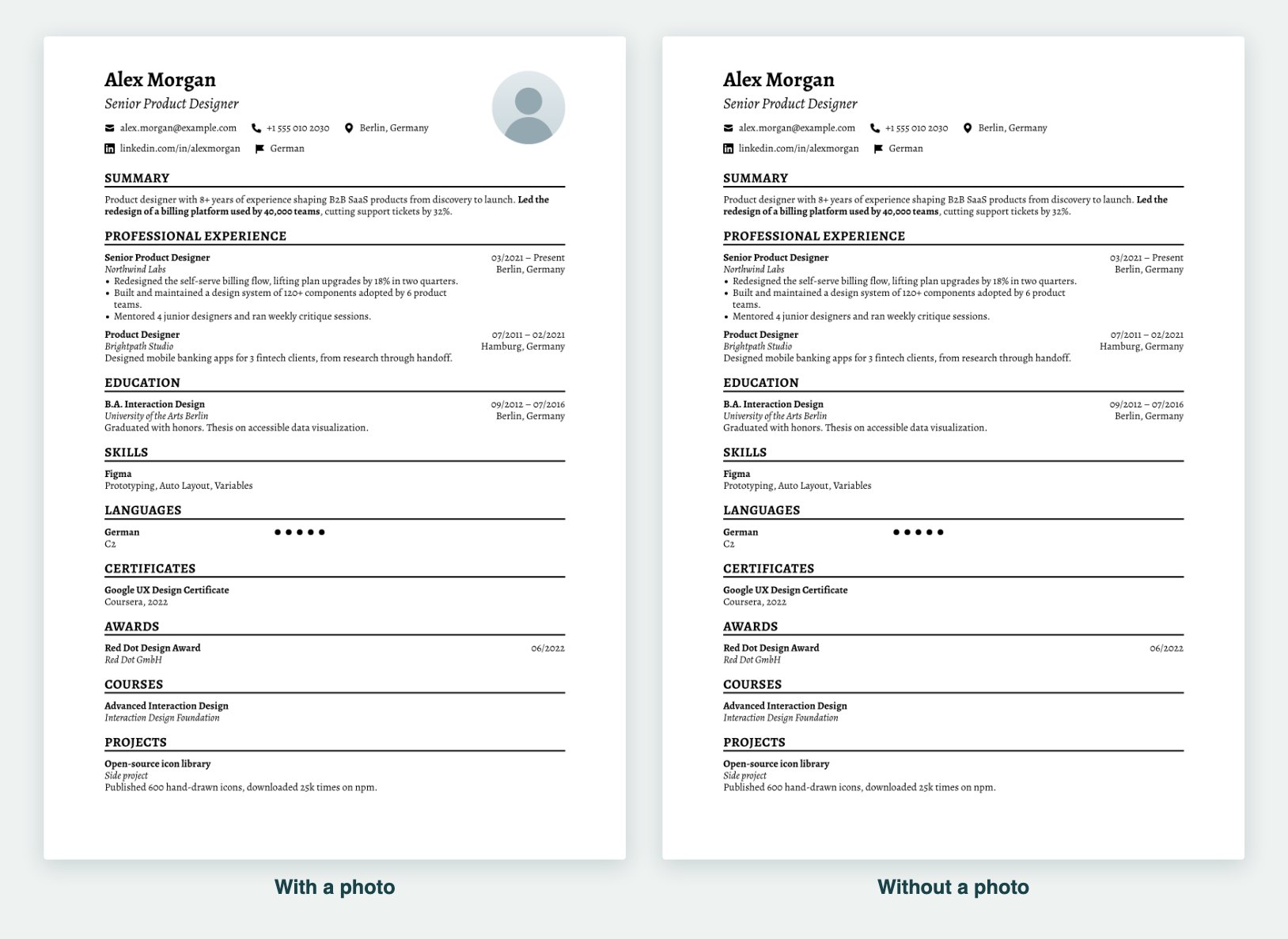
So a photo doesn't hide your words from the reader we tested. Some parsers may still handle the layout around it less well, which is one more reason to leave it off where nobody expects one.
Do photos change who gets called back?
Yes. Several field experiments, in which researchers sent matched applications to real job adverts, found that the photo changed employers' replies.
In Germany, Doris Weichselbaumer sent 1,474 applications from three fictional women with identical qualifications. The one with a German name got positive replies from 18.8% of employers, the one with a Turkish name from 13.5%, and the one with a Turkish name wearing a headscarf in her photo from 4.2%. Germany was chosen, in the study's words, because "job seekers typically attach their picture to their résumé".
In Israel, a study of 5,312 CVs found that attractive men got nearly twice the callbacks of plain-looking men, while women who sent no photo were called back more often than women who sent one.
In Argentina, attractive applicants got 36% more callbacks. In China, applicants with unattractive photos needed 33% more applications to get the same number of interviews.
All four studies were published in peer-reviewed journals. None of them ran in the US, the UK, Canada or Australia, where photos are rare enough that employers don't expect one.
What about Europass?
Europass, the EU's CV template, tells everyone to "add a professional photograph of yourself". The EU's own EURES country pages disagree for some countries. They say no photo unless asked for Belgium, Italy and Ireland. Treat Europass's advice as a default for its template and go by the country you're applying in.
If you include a photo, what should it look like?
Only the photo countries give specifications, and they agree on the basics.
- A recent photo of you alone, head and shoulders or chest up, facing the camera
- A plain, neutral background
- Clothes that match what people wear in the job you want
- A professional photo where possible. Germany's employment agency lists a phone selfie and a plain passport photo among its don'ts
Sizes differ by country. Germany's agency suggests roughly 4 × 6 cm to 4 × 8 cm on the CV, the University of Zurich 4.5 × 6.5 cm to 6 × 9 cm, and a Japanese rirekisho photo is usually 40 × 30 mm. The Philippine Personal Data Sheet wants 3.5 × 4.5 cm, taken within six months.
How to add or hide a photo in OneCV
In OneCV, the photo is part of your personal details, and 42 of the 105 templates have a place for it. Browse them on the photo resume templates page.
- Open your resume, go to Personal Details and add a photo. You can crop it before it's saved.
- In the Customize tab, open the Photo settings to choose its Size (five steps), Shape and Photo Position. The portrait shapes suit the German and Japanese style, and Grayscale turns it black and white.
- Untick Show to take the photo off the PDF without deleting it.
The Show setting is what makes one resume work in several countries. Keep the photo on for an application to Germany and off for one to the UK, and download the PDF each time. Keeping a separate copy for each country needs Pro, at $10 a month or $48 a year, because the Free plan includes one resume. Every PDF downloads without a watermark on both plans.
Frequently asked questions
Is it illegal to put a photo on a resume in the US?
No. US anti-discrimination guidance tells employers not to ask for a photo before an offer, and it doesn't stop you sending one. It's still a bad idea, because US employers don't expect one and careers services advise against it.
Should I put a photo on my CV in the UK?
No, unless the job is acting or modelling or the advert asks. UK university careers services and Prospects all say to leave it off.
Should I put a photo on my CV for jobs in Dubai?
Sources disagree. Zayed University's careers guide says no pictures, Michael Page says photos are often best left out, and some job boards say most Dubai employers like to see one. Customer-facing roles are the exception, and Emirates requires photos from cabin crew applicants. If the advert doesn't ask, a professional photo is acceptable and leaving it off is safe. Our UAE CV format guide covers the rest.
Should I put a photo on my resume in India?
Follow the format the employer or your placement cell gives you. IIT Madras bans pictures on internship resumes, while other colleges ask for a formal photo, so there's no single Indian rule.
Should I put a photo on my resume in the Philippines?
For government jobs, yes, because the Personal Data Sheet requires one. For private-sector jobs a photo is common, though JobStreet Philippines itself advises leaving it off, so follow what the advert asks for.
Where should my photo go if I leave it off my resume?
On your LinkedIn and job-site profiles. New Zealand's government careers service, which says not to use images on a CV, tells people to use a professional headshot on online job profiles.
Pick a template, set the photo for the country you're applying to, and download. Create your free account to try it with your own resume.