 Bisrat Shibeshi
A resume should be one page if you're a student or in the first few years of your career, and up to two pages once you have around ten years of relevant experience. Go past two pages only for an academic CV. For US federal jobs, two pages is now a hard limit.
| Your situation | Length |
|---|---|
| Student or recent graduate | One page |
| Up to about 10 years of experience | One page, or two if both are full of relevant work |
| 10 years or more, or senior roles | Up to two pages |
| US federal job | Two pages at most, on US Letter |
| UK or European CV | Up to two A4 pages |
| Academic CV | As long as your record needs |
Page count is really a word count. In our tests, a full resume page held between about 300 and 450 words, depending on the template. The rest of this guide covers what employers and career offices say, what fits on a page, and how to get to one page or lay out two.
What do career offices and employers say about resume length?
They agree on one page for students and two pages at most for nearly everyone else. UC Berkeley's career office says "for college students, we recommend a simple, one-page format", and Duke's career center tells its students to keep the resume to one page.
For people with more experience, the ceiling is two pages. MIT's career office advises aiming for "one page or two pages maximum if you have substantial relevant information". Harvard's career office describes a resume as "1-2 pages at most", and Stanford's business school tells its alumni "maximum of two pages".
No independent research settles one page against two. What exists is consistent practice from the people who teach resume writing, and a hard rule in a few places, such as US federal jobs.
Is a two-page resume OK?
Yes, when both pages are full of work that matters to the job. Two pages become a problem when the second one holds a few leftover lines or experience from a decade ago that nobody will weigh.
The best-known evidence comes with caveats. A 2018 eye-tracking study by the job site Ladders found that "an engaged recruiter will spend as much time on a second page as on the first", and added that time on page two depends on how compelling page one is. The report doesn't give a sample size, and the study isn't peer-reviewed.
A 2018 study by a resume-writing company is often quoted as proof that recruiters prefer two pages, because its 482 participants picked two-page resumes more often. Its two-page test resumes also held 700 to 850 words against 350 to 500 for the one-pagers. So the study can't separate the effect of page count from the effect of having more to say.
So put your strongest work on page one, and add a second page only when you have enough relevant material to fill it.
How many words fit on a one-page resume?
About 300 to 450, depending on the template's font, spacing and layout. We measured it by rendering a fictional operations manager's resume in four OneCV templates, at each template's default settings, and counting the words on page one. To see how much a full page holds, we also ran a longer version that overflowed every template.
| Template | Type and spacing | Words on page one, US Letter | Words on page one, A4 |
|---|---|---|---|
| Clean Slate | 10 pt, narrow margins, side column | 413 | 456 |
| Classic Clear | 10.5 pt, one column | 425 | 437 |
| Atlantic Blue | 10 pt, sidebar | 321 | 321 |
| Pure Baseline | 11.5 pt, generous line spacing | 305 | 318 |
Daniel, our fictional manager, has 11 years in warehousing and four jobs, and his resume runs to 382 words. That's a realistic length, and it fit on one page in only one of the four templates. In Classic Clear, everything fit on page one except his certificates and languages, which spilled onto page two.
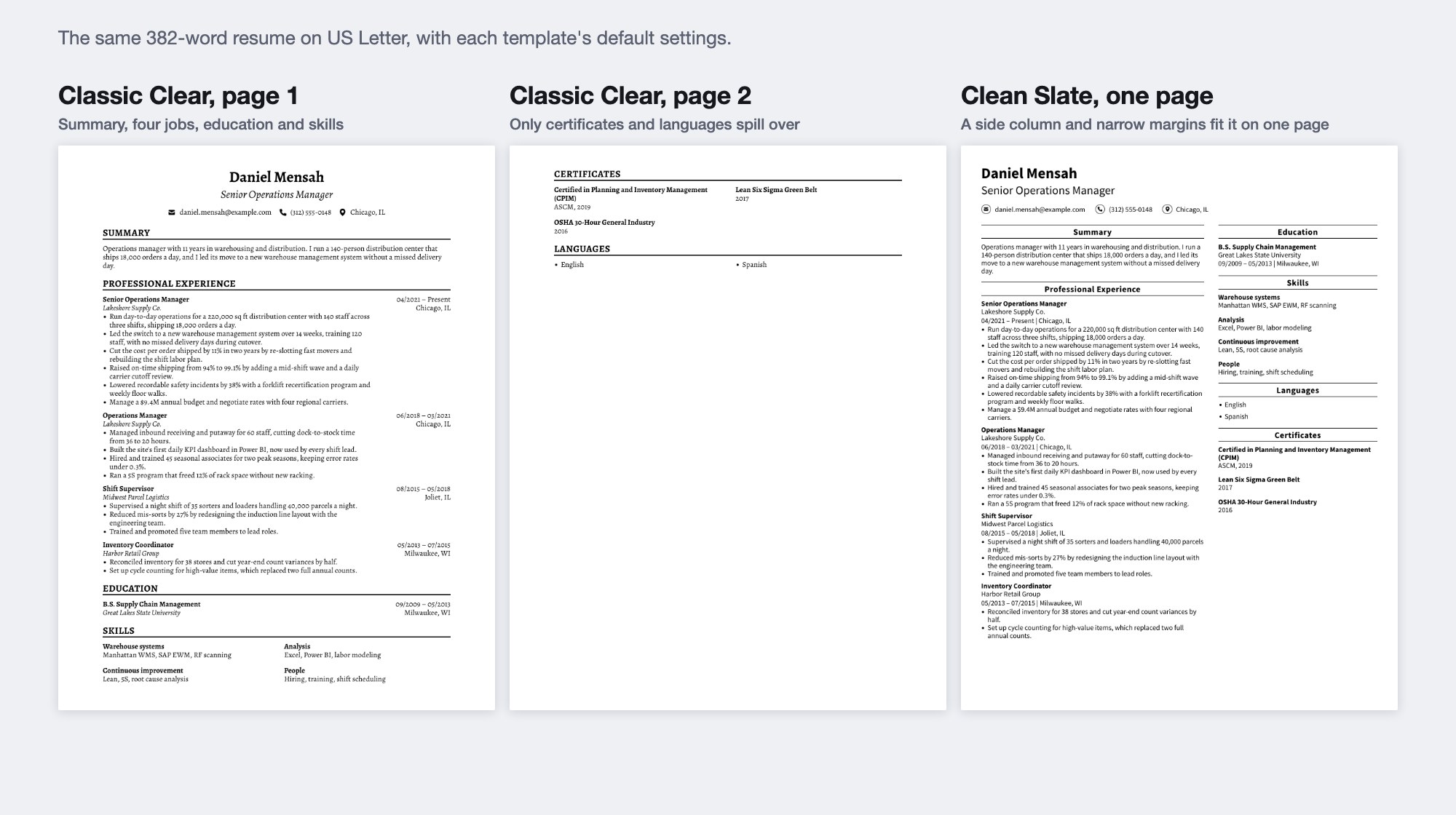
A second page holding two short sections looks like an accident. When you're that close, move to one page. If your resume runs well past 450 words, plan for two pages and fill the second one properly.
Paper size makes a small difference too. A4 is taller and narrower than US Letter, and in our compact template it held about 10% more words. Use the size the country expects, as our A4 vs US Letter guide explains.
How do you get your resume onto one page?
Cut before you shrink. A smaller font makes the page harder to read, while a shorter resume is usually a stronger one.
- Shorten old jobs. Roles from more than ten years ago rarely need more than a title, employer and dates, or one line of results.
- Remove bullets that repeat each other. If two bullets describe the same skill, keep the one with a number in it.
- Merge short sections. Certificates and languages can share a line or move into a skills section.
- Trim the summary to two or three lines.
- Then adjust the design. Reduce the margins, line height and space between elements a step at a time, or switch to a compact template.
Keep the type readable while you do it. MIT recommends body text of at least 10 point with margins between half an inch and an inch, and USAJOBS suggests 10-point body text with half-inch margins.
How should you lay out a two-page resume?
Put the work that matters most for this job on page one, because that's what earns attention for page two. Your most recent role and your strongest results belong there.
Put your name on page two as well. Stanford's business school advises putting your name and email on the second page "in case the pages get separated". Page numbers help for the same reason.
Then fill the second page. A two-page resume where page two runs to a third of a page looks the same as an overlong one-pager. Either cut it back to one page or give the extra space to relevant detail, such as fuller bullets for your last two roles.
How long should a CV be?
In the UK and most of Europe, a CV is the everyday job document and runs to two A4 pages at most. Prospects quotes the University of Chester's careers service, which recommends "no longer than two A4 pages", shorter for students applying for part-time jobs and slightly longer for academic CVs.
In the US, a CV usually means an academic CV, and that has no page limit. Berkeley says it should be "as long as it takes to state one's qualifications", and MIT says there is "no strict page limit". Publications, talks and teaching are listed in full, so an academic CV grows with your career.
How long can a federal resume be?
Two pages. Since the Office of Personnel Management's Merit Hiring Plan of May 2025, "there will be a 2-page limit on resume length". USAJOBS says federal agencies only accept resumes up to two pages, and its system won't let you upload or build a longer one.
OPM's memo says the plan "will prohibit the current longform Federal resume structure", so older multi-page federal resumes need cutting down. USAJOBS recommends US Letter paper, half-inch margins, 10-point body text and a sans-serif font. Our resume formats guide covers the rest of the federal format, including month and year dates for each job.
How to check your resume's length in OneCV
OneCV's resume builder shows page breaks in the live preview as you type, so you can see when you've spilled onto page two.
- To fit one page, open the Customize tab and lower the settings in the Spacing card a step at a time (line height, space between elements, and the two margin settings). The Font Size card shows the base size in points, so you can keep it at 10 point or above.
- To fit more on a page without touching the settings, try one of the 9 compact templates, such as Clean Slate. All 105 templates are on the Free plan.
- For a two-page resume, turn on page numbers and your name in the Footer card, so both appear on every page.
- To change paper size, use Page Format in the Document card. Switching between A4 and US Letter moves the page breaks, so check the preview after.
You can download the PDF as often as you like on the Free plan, with no watermark. If you're tailoring a longer master resume down for each job, our guide to tailoring your resume to a job description shows what to cut, and our guide to cover letter length covers the letter that goes with it.
Frequently asked questions
Is a one-page resume still the rule?
For students and early-career applicants, yes. Berkeley and Duke both tell students to keep to one page. With about ten years of relevant experience, two full pages are normal, and MIT, Harvard and Stanford all set two pages as the maximum.
How long should a resume be with 10 years of experience?
One or two pages. If your relevant work fills two pages with results, use two. If it takes a page and a half, cut it to one or add relevant detail until the second page is nearly full, because a mostly empty second page reads as padding.
Is a one-and-a-half-page resume OK?
It works, but it rarely looks its best. Half-empty second pages are common when only a section or two spills over. Trim to one page, or add relevant detail until the second page is close to full.
What's the smallest font size I can use to fit one page?
Keep body text at 10 point or larger. MIT recommends at least 10 point with margins of half an inch to an inch, and USAJOBS suggests 10 point with half-inch margins for federal resumes. If you need to go smaller, cut content instead.
Should a student's resume ever be two pages?
Rarely. Career offices at Berkeley and Duke advise one page for undergraduates. Graduate students with research, publications or several years of work may need two, and an academic CV can be longer.
How long should a resume be for a federal job?
Two pages at most. USAJOBS won't let you upload or build a longer resume, under the Merit Hiring Plan that took effect in 2025.
Create your free OneCV account and check how your resume fits on the page.