 Bisrat Shibeshi
For most people in 2026, a chronological resume is the right choice. It lists your jobs newest first with results under each, and it's the format employers and applicant tracking systems expect. Choose a hybrid if you're changing careers or have a gap to explain, and use a purely functional resume only when your job history works against you.
| Your situation | Format to use |
|---|---|
| Steady work history in the field you're applying to | Chronological |
| Student or recent graduate | Chronological, with education first |
| Changing careers | Hybrid |
| A gap in your work history | Hybrid, with the gap listed honestly |
| Returning to work after a long break | Hybrid, or functional if most of your history is old |
| Applying for a US federal job | Chronological, with month and year dates, two pages at most |
No single format is right for everyone. UC Berkeley's career office says "there is no 'best' format for all resumes", and California's state HR department says "there are no hard-and-fast rules". This guide shows one person's resume in all three formats so you can see the trade-offs.
What are the three resume formats?
The US Bureau of Labor Statistics describes three main resume formats, and career offices use the same three today.
- A chronological resume, also called reverse-chronological, lists your jobs by date with the most recent first, and puts your results under each job.
- A functional resume, also called a skills-based resume or skills-based CV, groups your achievements under skills instead of job titles, with a short list of jobs below.
- A hybrid resume, also called a combination resume, starts with a short summary of your main skills and then gives your full job history in date order.
Here's one fictional operations coordinator, Priya, written all three ways. The jobs and results are the same in each.
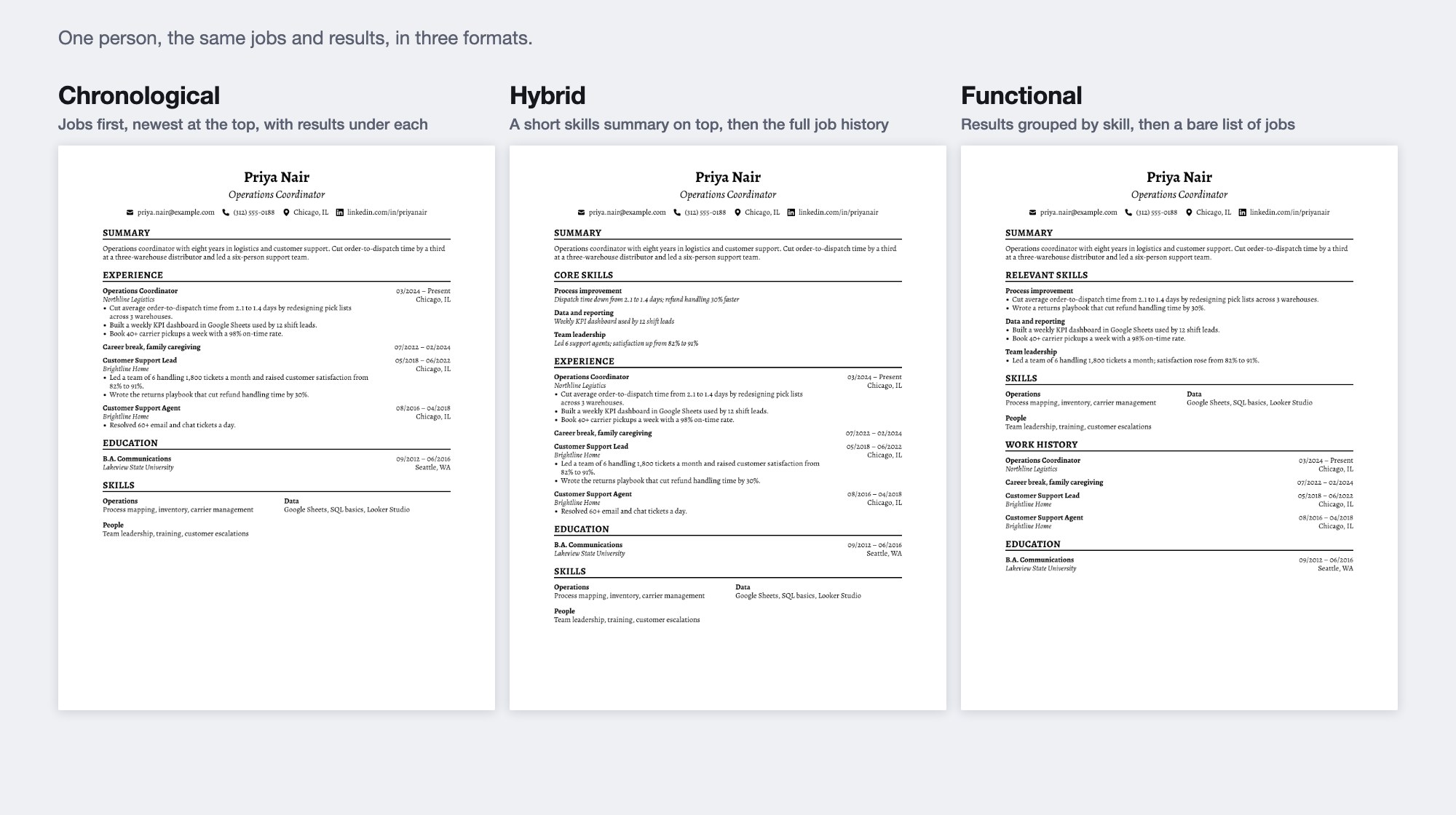
In the chronological version, a recruiter sees what Priya did in each role and when. The hybrid version adds three lines at the top that answer "what is she good at" before the job history starts. The functional version leads with those strengths in more detail and keeps only titles and dates for her jobs, so it's harder to see which result came from which job.
When should you use a chronological resume?
Use it whenever your recent jobs match the job you want. CalHR, California's state HR department, calls it "the most common format" and the best fit for people with an employment history without large gaps. UC Berkeley's career office recommends it for more conservative industries such as banking.
It's also the default for students. USC's career center calls reverse-chronological "the most acceptable and readily used resume format for college students". With little work history, the order changes but the format doesn't. Put education first, then projects and experience, each newest first, as in our internship resume example.
When is a functional resume a good idea?
Rarely, and mostly when your past jobs don't support the job you want. CalHR says a functional resume can help people going back into the job market, people changing careers and recent graduates with little experience, and that it lets you downplay gaps. UC Berkeley says it works if you have little work experience or are changing careers.
The catch is that employers have tended to prefer the chronological kind. A 2009 study of employer preferences in Business Communication Quarterly found employers "still widely prefer the standard chronological résumé". The research is old and doesn't all point one way, though. An earlier study of 230 personnel professionals, from 1987, rated applicants with functional resumes more highly. We found no recent independent study comparing the formats, so treat any confident claim about what recruiters think of functional resumes with care.
Applicant tracking systems are a more practical concern. CareerOneStop, the US Department of Labor's careers site, advises using a chronological work history, with jobs listed by date, so the system can read it. A functional resume with no dated job history leaves those fields empty when the software builds your candidate profile.
When should you use a hybrid resume?
When you need to lead with skills but still want a dated job history. CareerOneStop goes further than most and says "a combination of these formats works well for most people". It describes the combination format as a summary of qualifications at the top, followed by your work history.
A hybrid suits a career change, because the summary can lead with the skills that carry over before the reader reaches job titles from another field. It also suits a gap. Priya's resume lists "Career break, family caregiving" with its dates in all three versions. A dated line like that answers the question before anyone asks it, and the hybrid puts her strengths first so the gap isn't the first thing a reader notices.
What changed for resume formats in 2026?
The formats themselves haven't changed, and we found no credible source describing a new 2026 format. Two things around them have.
- More employers say they hire on skills. In NACE's 2026 Job Outlook spring update, nearly 70% of the 185 employers surveyed said they use skills-based hiring. The survey was sponsored by Jobscan, which sells resume software. NACE also notes that listing your skills isn't enough, and that candidates need to show them through examples. A hybrid's skills summary works best when every line carries a result.
- US federal applications now have a two-page limit. Since the Office of Personnel Management's 2025 Merit Hiring Plan, USAJOBS says federal agencies only accept resumes up to two pages long, with month and year dates for each job.
How to switch between formats in OneCV
Chronological and hybrid use the same content, so switching takes a minute in OneCV's resume builder.
- To make a chronological resume into a hybrid, add a Custom section, name it Core Skills or Summary of Qualifications, and write three or four lines that each pair a skill with a result.
- In the Customize tab, use Change Section Layout in the Layout card to drag that section above Experience.
- To go back, drag it below Experience or delete the section.
A functional resume needs rewriting, because the bullets move from your jobs into skill groups. Duplicate your resume first so you keep the chronological version. Keeping both copies needs Pro, since the Free plan holds one resume. Whatever the format, the design settings and all 105 templates work the same way, and our guide to changing your template without retyping covers switching designs.
Frequently asked questions
What is the best resume format in 2026?
Chronological for most people. It's the most common format and the one employers and applicant tracking systems expect. Use a hybrid if you're changing careers or have a gap to explain.
Is a functional resume a red flag?
It can raise questions, because it makes it harder to see what you did in each job and when. A 2009 study found employers preferred chronological resumes, though older research was mixed. If you want to lead with skills, a hybrid gives you that and keeps a dated job history.
Can applicant tracking systems read a functional resume?
They read the text, but a resume with no dated job history leaves gaps in the profile the software builds. CareerOneStop advises a chronological work history with each job's dates. Our guide to what applicant tracking systems reject covers how that profile is used.
Which resume format is best for a career change?
A hybrid. Lead with a short summary of the skills that carry over, each with a result, then list your jobs by date. CareerOneStop notes that a purely chronological resume doesn't work as well when you're switching careers.
How do you show a gap on a resume?
List it as an entry with its dates and a short reason, such as "Career break, family caregiving". A hybrid format then puts your strongest skills ahead of the job history.
What is the difference between a hybrid and a combination resume?
Nothing. They're two names for the same format, a skills summary at the top followed by a chronological job history.
Create your free OneCV account and start with a chronological resume. You can add a skills summary later without retyping anything.