 Bisrat Shibeshi
To write an internship resume with no work experience, put your education at the top, then fill the space a job history would take with projects, coursework, part-time jobs, volunteering and campus activities. Describe each one by what you did and what came of it, with a number where you can. Keep the whole thing to one page.
"No experience" usually means no internships yet. Almost every student has done things that count, such as class projects, a weekend job, tutoring, a club role or a hackathon. As MIT's careers office puts it in its resume guide for first-year students, experience is a broad term that covers the things you have done.
Below is a one-page example for a fictional computer science student, followed by how to build each section.
What does an internship resume with no experience look like?
Here's the order we'd use for a second-year student applying for a software engineering internship. Each note explains why that section sits where it does.
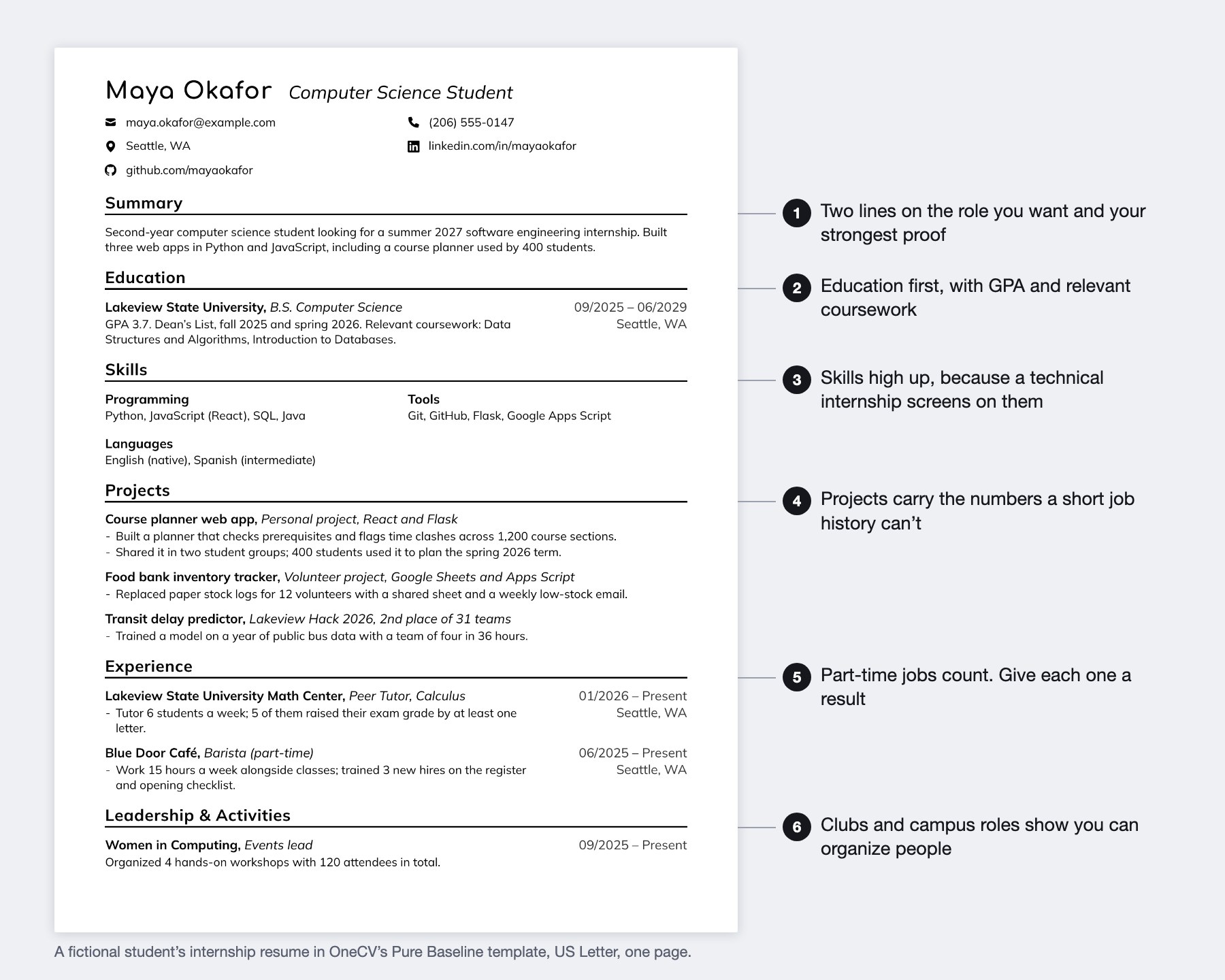
Swap the details for your own field. A marketing student might lead Projects with a campaign for a student society, and a biology student might add a Lab Skills group under Skills.
Which sections go on an internship resume?
Use these sections, in this order, and leave out any you have nothing for.
- A header with your name, email, phone number, city, and a LinkedIn or portfolio link if you have one.
- A summary of two lines at most, naming the internship you want and the best evidence you have. It's optional, but it tells a reader in seconds what you're applying for.
- Education, with your degree, school, expected graduation month and year, and your GPA if it helps you. A line of relevant coursework fits here too.
- Skills, grouped, such as programming languages, tools and spoken languages.
- Projects, from class, from your own time or from a hackathon.
- Experience, for part-time jobs, tutoring, research assistant roles and any previous internship.
- Leadership and activities, for clubs, societies, volunteering and sports teams.
MIT's guide recommends keeping Education at the top for most first-year students. It's usually your strongest section while your experience is short. Within each section, list dated entries newest first.
What counts as experience when you've never had an internship?
More than most students list. Anything where you did real work and can name a result belongs on the page.
- Class projects, especially group projects with a deliverable, such as an app, a report or a model
- Personal projects, from a website to a small business you ran
- Hackathons and case competitions, with your placing if you placed
- Part-time and summer jobs, including retail, food service and campus jobs
- Tutoring, teaching assistant and research assistant work
- Volunteering, and committee or leadership roles in clubs and societies
You don't need to call all of it "Experience". MIT suggests grouping entries under headings that fit the role, such as Projects or Leadership Experience, so the most relevant work is easy to find.
How do you describe projects and part-time jobs?
Start each bullet with an action verb, say what you did, and finish with a result. MIT calls this a PAR statement (project, activity, result) and advises quantifying where you can. Estimates are fine while you start keeping track.
The task alone rarely helps, because the reader can already guess it. These pairs show the difference.
| Instead of | Write |
|---|---|
| Worked as a barista | Trained 3 new hires on the register and opening checklist while working 15 hours a week |
| Made a website for a class | Built a course planner in React and Flask that 400 students used to plan their term |
| Member of Women in Computing | Organized 4 hands-on workshops with 120 attendees in total |
| Tutored students in math | Tutor 6 students a week in calculus; 5 raised their exam grade by at least one letter |
Use as many bullets as an entry deserves. MIT's guide says one strong bullet is fine for a small role, and you don't need the same number under every entry.
Which skills belong on an internship resume?
List skills a reader can check, such as programming languages, software, lab techniques and spoken languages. MIT recommends keeping the skills section to technical, procedural, language or laboratory skills, and showing teamwork or leadership through your bullets instead, where they come with context.
Group them if the list runs long. Programming, Tools and Languages is a common split for a technical internship.
How long should an internship resume be?
One page. MIT's guide describes your resume as "an 8½ by 11-inch piece of real-estate", and a first reader may give it only a few seconds. If it runs onto a second page, shorten or combine entries before you shrink the text.
Keep the type readable. MIT advises staying at 10 point or larger, with 11 point working for most fonts, and margins between half an inch and an inch. Our example fit on one page after moving coursework into the Education entry and lowering the font size and line spacing a couple of steps.
US internships use US Letter paper. If you're applying in the UK, Europe or most of Asia, use A4, as our A4 vs US Letter guide explains.
Should you change your resume for each internship?
Yes, a little. Read each posting and move the projects and skills it asks for higher up the page, using the posting's own words where they honestly describe what you did. MIT's guide makes the same point and suggests putting quality ahead of the number of applications. Our guide to tailoring your resume to a job description shows which parts to change.
Answer the application form's screening questions carefully too. Questions about work authorization, graduation date or location are the kind employers use as automatic filters, as we cover in what applicant tracking systems reject automatically.
How to build an internship resume in OneCV
OneCV's resume builder has 29 first-job templates on the Free plan, including Pure Baseline, the one in our example. You can drag Education above Experience, add sections for Projects, Courses and Organisations, and rename any heading, so Organisations can read Leadership & Activities. If the page spills over, the spacing settings let you tighten the font size and line height a step at a time.
The Free plan includes one resume with unlimited PDF downloads and no watermark. Keeping a tailored copy for each internship needs Pro, and students who verify a school email get 25% off Pro for their first 12 months. If you're still choosing a tool, our list of free resume builders for college students compares the options.
When you apply, send a short cover letter with it. Our guide to a cover letter with no experience uses this same student's resume and shows a matching letter.
Frequently asked questions
What should I put on a resume for an internship with no experience?
Your education, then projects, relevant coursework, part-time jobs, volunteering and campus activities. Describe each with what you did and a result, and keep the resume to one page.
Should I include high school on my internship resume?
In your first year, you can. MIT's guide says first-year students may keep high school on the resume to show coursework, test scores or GPA, and remove it later as university entries take its place.
Should I put my GPA on an internship resume?
Include it if it helps you. It sits with your degree in the Education section, and many students add Dean's List or honors on the same line.
Do I need a summary on an internship resume?
It's optional. Two lines naming the internship you want and your strongest evidence help a reader place you quickly. Skip it if it would only repeat your Education section.
How do I list a previous internship on my resume?
Put it under Experience like any job, with your title, the organization, location and dates, then two or three bullets on what you did and what came of it.
Should I send my internship resume as a PDF or Word file?
Either works for most application systems. MIT's guide lists DOC, DOCX and PDF. Send a PDF with selectable text unless the posting asks for Word.
Create your free OneCV account and pick a first-job template.