 Bisrat Shibeshi
A cover letter with no experience works the same way as any other. Name the role and why you want it, then spend two short paragraphs on evidence from your degree, projects, part-time jobs, volunteering or campus activities. Close by asking for a conversation. Keep it to one page and three to five short paragraphs, and address it to a person by name when you can find one.
Leave out apologies for what you haven't done yet. Prospects, the UK graduate careers service, puts it plainly in its no-experience sample: "Focus on what you can do, not what you can't."
Below is a full example for a student applying for an internship, then each part of the letter in turn.
What does a cover letter with no experience look like?
This is the letter a fictional second-year computer science student, Maya, wrote for a software engineering internship. It has four short paragraphs and a body of 189 words, and fits on one page.
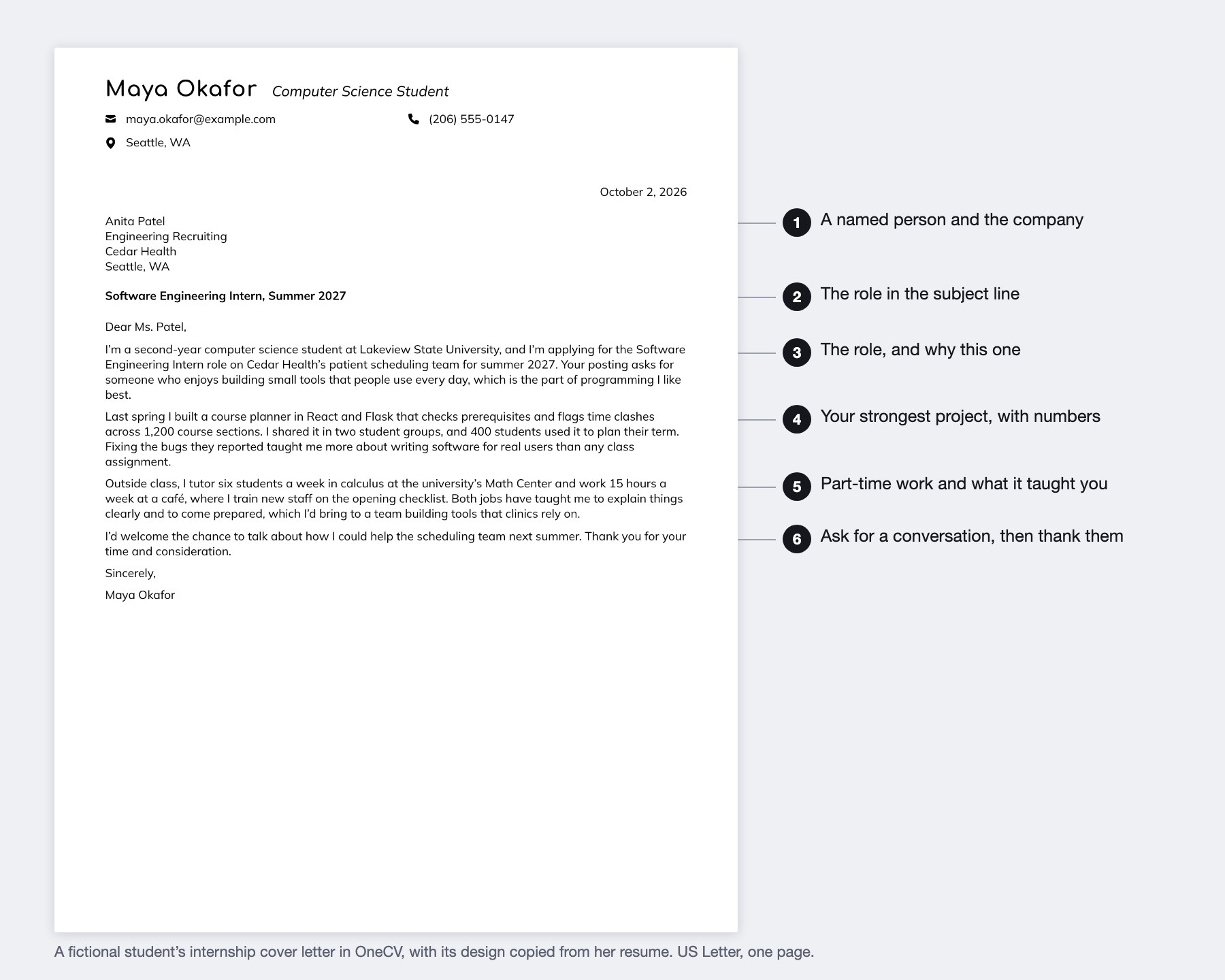
Maya has never had an internship. The letter still gives a recruiter three concrete things, a tool 400 students used, a tutoring role and a part-time job, each tied to something the posting asked for.
How do you structure a cover letter with no experience?
Career services give similar numbers. The UK's National Careers Service says three to five paragraphs, the University of Michigan says three to four, and MIT's career office says no longer than one page with a font between 10 and 12 points. Four paragraphs fit all three.
- Opening, two or three sentences. Say which role you're applying for and why this one appeals to you. If you're a student, say what you study and which year you're in.
- First evidence paragraph. Your strongest example, often a project or piece of coursework that matches the posting, told with what you did and what came of it.
- Second evidence paragraph. A part-time job, volunteering or a club role, and the skill it gave you that the job needs.
- Close. Ask for a conversation and thank the reader.
Prospects suggests starting the evidence with your degree and any relevant modules, then adding part-time jobs and the skills you gained from them. Michigan names academic, work, volunteer and co-curricular experiences as all fair game.
Who should you address a cover letter to?
Work down this list and stop at the first one you can use.
- A named person, such as the recruiter or hiring manager in the posting, or one you find on the company's careers page or LinkedIn. "Dear Ms. Patel," is ideal.
- A role title, such as "Dear Internship Coordinator," or "Dear Engineering Recruiting Team,". Michigan recommends a title when you can't find a name.
- "Dear Hiring Manager,", which both MIT and UC Berkeley suggest when you're not sure who will read it.
Skip "To Whom It May Concern". Michigan's career center lists it as one to avoid, even though some popular templates still use it. In the UK, "Dear Sir or Madam" is the conventional fallback, according to the National Careers Service.
Don't spend an hour hunting for a name, either. MIT's Communication Lab notes that a generic greeting won't sink your application, while a typo in someone's name can hurt it.
What do you say instead of "I have no experience but I'm willing to learn"?
Swap the apology for something you've done that shows you learn quickly. Every line below says "I'm willing to learn" without asking the reader to take it on trust.
| Instead of | Write |
|---|---|
| I don't have much experience, but I'm a fast learner. | I taught myself Flask to build a course planner that 400 students used to plan their term. |
| Although I haven't worked in marketing, I'm eager to learn. | I ran the social media accounts for our debate society this year and doubled its event sign-ups. |
| I have no customer service experience, but I'm a people person. | I work 15 hours a week at a café, where I handle the morning rush and train new staff. |
Use your own numbers, and estimate honestly if you don't have exact ones. "Doubled its sign-ups" only works if it's true.
How do you turn student experience into what employers want?
Read the posting line by line, as MIT's Communication Lab suggests, and mark the skills it asks for. Most postings name them. In NACE's Job Outlook 2026 survey of 183 employers, more than 80% said their job ads name the main skills the position needs.
Then match each one to something you've done. In NACE's survey of what employers look for on student resumes, nearly 90% said they look for evidence of problem-solving, so lead with an example of a problem you solved.
| What you did | What it shows |
|---|---|
| A group project with a deadline | Teamwork, and solving problems under time pressure |
| Treasurer of a student club | Handling money, budgeting and keeping records |
| A retail or café job | Dealing with customers and staying calm when it's busy |
| Tutoring or peer mentoring | Explaining hard ideas clearly |
| A personal project people used | Taking something from idea to finished, and learning tools on your own |
Before you send it, try Prospects' test. Remove the company's name and read the letter again. If it would work for any company, it isn't tailored yet.
Do employers still read cover letters?
Some do, and you usually can't tell which. UC Berkeley's career office says it "depends on the recruiter and hiring manager" and advises sending one even when the application says it's optional. MIT's Communication Lab notes that not all jobs put much weight on it.
When managers have been asked, many say it helps. In a 2020 survey of more than 2,400 US senior managers by the staffing firm Accountemps, reported by AARP, 58% said cover letters were very helpful. For a student with a short resume, the letter is also the one place to explain why you want this particular role.
Can you use ChatGPT or another AI to write your cover letter?
You can use it to help, and you should rewrite what it gives you. MIT's career office suggests treating AI as a brainstorming partner, and Prospects advises using it to edit your documents, not to write them entirely.
There's some early evidence behind that advice. A 2025 working paper by Cui, Dias and Ye studied cover letters on an online jobs platform and found that the time people spent editing AI-generated drafts was positively correlated with being hired. It hasn't been peer reviewed yet, but it points the same way as the careers advice. A draft is a starting point, and the edits that add your own examples are what count.
Which cover letter mistakes should you avoid?
- Repeating your resume in paragraphs. MIT warns against it, and Prospects calls rewriting your CV a mistake that sends an application "straight to the bin".
- Talking only about what the company can do for you, a mistake Prospects lists by name.
- Starting every sentence with "I". Michigan's career center flags it.
- Copying a template word for word. Prospects says templates should only be used as a guide.
- Typos, especially in the recipient's or company's name.
- Apologizing for your lack of experience instead of showing what you've done.
How to write your cover letter in OneCV
OneCV's cover letter builder sits next to your resume. In the letter editor, Copy from resume fills in your name, email and phone, and Copy resume design in the Customize tab gives the letter the same fonts, colors and header as your resume, which is how Maya's letter was made. There are 70 letter templates if you'd rather start from a design.
The Free plan includes one cover letter alongside one resume, with PDF downloads and no watermark. Pro adds unlimited letters and an AI draft from a job posting, which works only from what your resume says, and students who verify a school email get 25% off. If you haven't written your resume yet, start with our guide to an internship resume with no experience.
Frequently asked questions
How long should a cover letter with no experience be?
One page at most, in three to five short paragraphs. MIT's career office says no longer than one page with a 10 to 12 point font. Our example's body is 189 words.
How do I say I have no experience but I'm willing to learn?
Show it with an example instead of saying it. Name something you learned on your own or quickly, such as a tool you picked up for a project, and what you did with it.
Should I send a cover letter if it's optional?
Yes, if you have time to tailor it. UC Berkeley's career office recommends sending one even when the application says it's optional, because some recruiters read them closely.
Can I use the same cover letter for every application?
No. The National Careers Service advises writing a new one for every job. Keep the structure, then change the opening and your examples to match each posting.
Can employers tell if a cover letter was written by AI?
There's no reliable way to know, and a generic letter reads as generic whoever wrote it. Use AI for ideas or edits, then put in your own examples and what this company asked for.
What's the difference between a cover letter and a resume?
The resume lists what you've done. The cover letter picks two or three of those things and explains why they make you a fit for this role. MIT advises against repeating your resume in paragraph form.
Create your free OneCV account to write your resume and cover letter side by side.