 Bisrat Shibeshi

Leave references off your resume unless the job ad or application form asks for them. That's the advice from government careers services and universities in the US, Canada, the UK, Ireland and New Zealand, and employers in those countries ask for referees near the end of hiring, usually once they're about to offer you the job. Have two or three people lined up before you apply, so you can send their details the day you're asked.
The exceptions are jobs whose advert or form asks for referees, which includes many public-sector jobs in Africa, and a few places where advice is split. The table below has the details.
Should you put references on your resume?
| Where the job is | Referees on the CV? | "References available on request"? |
|---|---|---|
| United States | No. Keep a separate reference page and send it when asked | Leave it out. The University of Cincinnati calls it "no longer necessary" |
| Canada | No. Canada's Job Bank says to keep them "on a separate sheet" until requested | Not covered by government advice |
| United Kingdom | No contact details unless the advert asks | Fine to use, and optional |
| Ireland | Not needed unless asked, though names add weight if you have room | Fine to use |
| Australia | Advice is split. SEEK says there's usually no need, while the Queensland Government lists referees among what employers look for | Common |
| New Zealand | Only if the job ad asks, and then at least two | The default the government careers service suggests |
| Kenya, Nigeria and South Africa | Yes for public-sector jobs, whose forms and adverts ask for named referees. Private-sector advice is split | Split |
| UAE | Usually not | Common |
The UK's National Careers Service says you shouldn't put someone else's contact details on your CV, and suggests writing that references are available on request instead. Canada's Job Bank goes further and tells you to "provide them only when they are specifically requested".
Public jobs are where the rule flips. Kenya's public-service application form has two referee slots, South African government posts ask for three contactable referees alongside the Z83 form, and Nigerian public-sector adverts usually ask for three. Our CV format guides for Kenya, Nigeria and South Africa cover what each form wants. Whatever the country, if the advert asks for referees, include them in the way it asks.
Should you write "References available upon request"?
It depends on where you're applying, and we found no evidence that the line helps or hurts. US advice says to drop it. The University of Cincinnati says the line used to be common practice and is no longer necessary, because employers know you'll provide references if they ask.
UK, Irish and New Zealand advice treats it as normal. The National Careers Service, the University of Kent and Trinity College Dublin all suggest it as the alternative to listing names. Prospects says you can include it but "most employers would assume this to be the case", so it's the first line to cut when you're short of space. If your CV runs onto a second page by one line, this is that line. Our guide to resume length has more ways to win the space back.
Can you name referees without giving their contact details?
Yes, and it's a good middle path when you have strong referees and the room. Trinity College Dublin's careers service suggests listing each referee's name, job title, employer and location, then adding "referee contact details available upon request". A reader sees who will vouch for you, and nobody's phone number goes out on a document you send to dozens of employers. Trinity says referees listed this way add weight to a CV.
When do employers actually check references?
Late, and usually only for the person they want to hire. Every official source we found puts the reference check at the end of the process.
| Who | When references are checked |
|---|---|
| UK employers, per ACAS | "at the final stage of the recruitment process when making a job offer" |
| NHS in England | After interview, "once a provisional offer of appointment has been made" |
| UK Civil Service | After you accept a provisional offer, covering at least your last three years |
| Irish public service | At the clearance stage after interview, and never your current employer without permission |
| Government of Canada | Step 4 of 5, after the written test or interview |
| US federal hiring (OPM) | Near the end, once the field is "narrowed to only a few competitors" |
So references listed on a first-round CV usually sit unused until the end. The timing also protects a job search you haven't told your boss about. ACAS says an employer should have made you a conditional offer, and have your permission, before contacting your current employer. Many offers say they depend on references, and an employer can withdraw a conditional offer if the references come back unsatisfactory.
How many references should you have?
Have three ready. US career services suggest three to five (Virginia Tech says "3 – 5 people"), while New Zealand's careers service asks for at least two and recent graduates in Ireland are told to give one academic and one work referee. Three meets the US minimum and leaves a spare everywhere else. When the advert names a number, give exactly that many.
Put your strongest reference first. Virginia Tech points out that employers often contact only the top two, so the order matters.
Who should you choose as a reference?
Start with people who have managed your work, and go back as far as you need to reach someone who knows it well.
- A current or recent manager or supervisor. If your current manager doesn't know you're looking, say so on the application. Employers usually need your permission before they contact a current employer.
- An earlier manager, a senior colleague you worked with closely, or a client.
- If you're a student or graduate, a lecturer, tutor, thesis supervisor or coach. NHS Employers names a "professor, academic tutor or head teacher" for people leaving full-time education.
- If you have no work history to draw on, a character reference from someone who knows you well, such as a volunteer coordinator. ACAS lists this as an option when a work reference isn't available.
Leave out relatives and close friends. Virginia Tech says "Family or close personal friends are not recommended", and the NHS rules require character referees who aren't related to you. Our internship resume guide covers building the rest of a CV when work history is thin.
Ask before you name anyone
Ask each person before you give out their name, and tell them what kind of job it is. A referee who knows the role can talk about the right things, and one who wasn't asked may say no. New Zealand's Privacy Commissioner tells people contacted out of the blue that it is up to them whether they give a reference. The University of Kent also links asking first to GDPR. The UK data regulator's recruitment guidance is written for employers and doesn't cover this, so it's good practice, and no law we found requires it.
What to include for each reference
For each person, give:
- their full name
- their job title and organisation
- how they know you, such as "my manager, 2021 to 2024"
- a phone number and an email address
A postal address used to be standard. Most of the advice we found leaves it out, although Virginia Tech still includes one and some public-sector forms, such as Kenya's, ask for it.
How to make a reference page
In the US and Canada, references go on their own page that you keep ready and send when an employer asks. Give it the same header as your resume, with your name and contact details, so the two documents look like a set. Virginia Tech says the header should match your resume's. Then list each reference with the details above, strongest first.
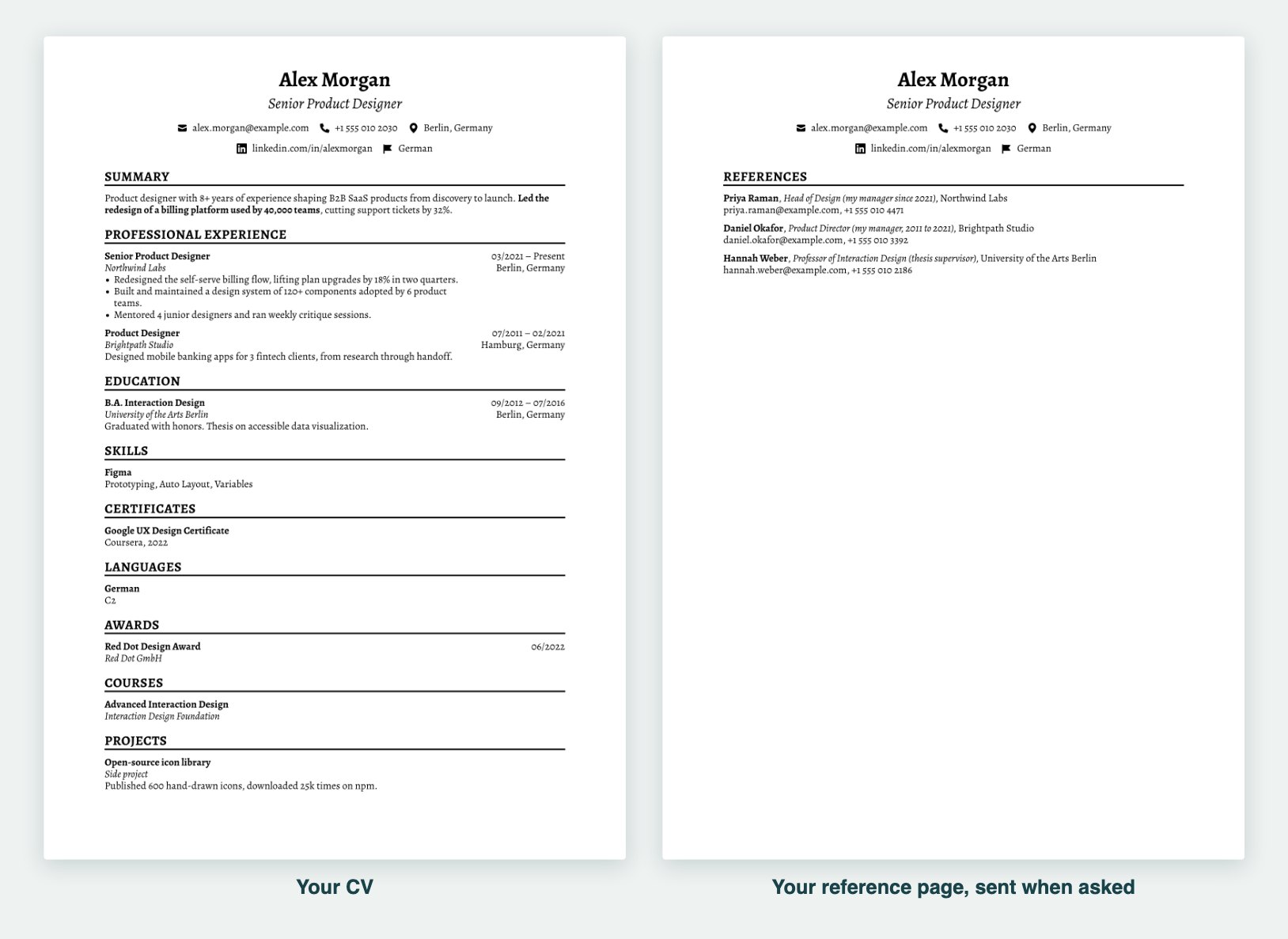
Bring printed copies to the interview too. Canada's Job Bank lists "copies of your reference list" among the things to take.
How to add references in OneCV
In OneCV's resume builder, references are a section like any other.
- Open your resume, choose Add Content and pick References.
- Fill in Name, Job Title, Organization, Email and Phone for each person. There's no separate field for how they know you, so add it after the job title, as in the example above.
- To call the section "Referees", the usual word in the UK, Ireland and most of Africa, open it and choose Edit Heading.
- In Customize, under Change Section Layout, drag References to the end. Drag the Page break above it if you want references on a page of their own.
You can keep your referees in OneCV without sending them every time. Each entry has a Hide entry toggle, and hidden entries don't appear in the PDF. Hide all of them and the section disappears from the PDF, so you can switch them on for the one application that asks and off again afterwards.
A separate reference page like the one in the image is a copy of your resume with every section except References deleted, so it keeps the same header. Keeping that second document needs Pro, at $10 a month or $48 a year, because the Free plan includes one resume. On Free, put References last with a page break above it, switch the entries on, download, and switch them off again. If you do send references on a second page, turn on the name and page numbers in the Footer settings so the page can't get separated from your CV.
Frequently asked questions
Does a former employer have to give me a reference?
In the UK, generally no. ACAS says an employer doesn't have to give a reference by law unless it promised one in writing, such as in your contract, the job is regulated by the FCA or PRA, or it was agreed another way, such as in a settlement agreement. Any reference it does give must be accurate and fair. In the US, the EEOC says it's illegal for an employer to give a negative or false reference, or refuse one, because of a protected characteristic such as race, sex, age or disability.
Can a friend or family member be a reference?
Avoid it. Career services advise against family and close friends, and some employers, including the NHS, don't accept character references from relatives. A friend you worked with closely counts as a colleague, so list them as one.
What if I don't have any work references?
Use a teacher, lecturer, tutor, coach or volunteer supervisor. ACAS suggests a reference from another manager, a different employer, or a personal or character reference from someone who knows you well, and NHS Employers accepts academic referees for people leaving education.
Should I attach reference letters to my application?
Only if the advert asks. The University of Cape Town's careers service says not to attach reference letters, and the sources that cover reference lists all say to wait until an employer requests them.
Is it "references" or "referees"?
Both, depending on where you are. The US and Canada say "references" for the people. The UK, Ireland, Australia, New Zealand and much of Africa say "referees" for the people and "references" for what they write. Use the word the advert uses.
Line up your three referees, ask them first, and keep their details ready in your CV. Create your free account to add a References section you can switch on when an employer asks.