 Bisrat Shibeshi

Start a cover letter by naming the job, saying how you found it or who referred you, and giving one specific reason you fit. End it by restating your interest, asking for a conversation and thanking the reader, then sign off with "Sincerely," or "Best regards," and your name. In the UK, use "Yours sincerely" when you've written to a named person.
| Part | What goes in it |
|---|---|
| First sentence | The job title and the company, or the name of the person who referred you |
| Rest of the opening | One specific reason you fit, in a sentence or two |
| Closing paragraph | Your interest in the role, a request for an interview or a conversation, and thanks |
| Sign-off | "Sincerely," "Best regards," or "Kind regards," in the US, and "Yours sincerely" or "Yours faithfully" in the UK |
| Your name | Typed under the sign-off, with a handwritten signature above it only on paper |
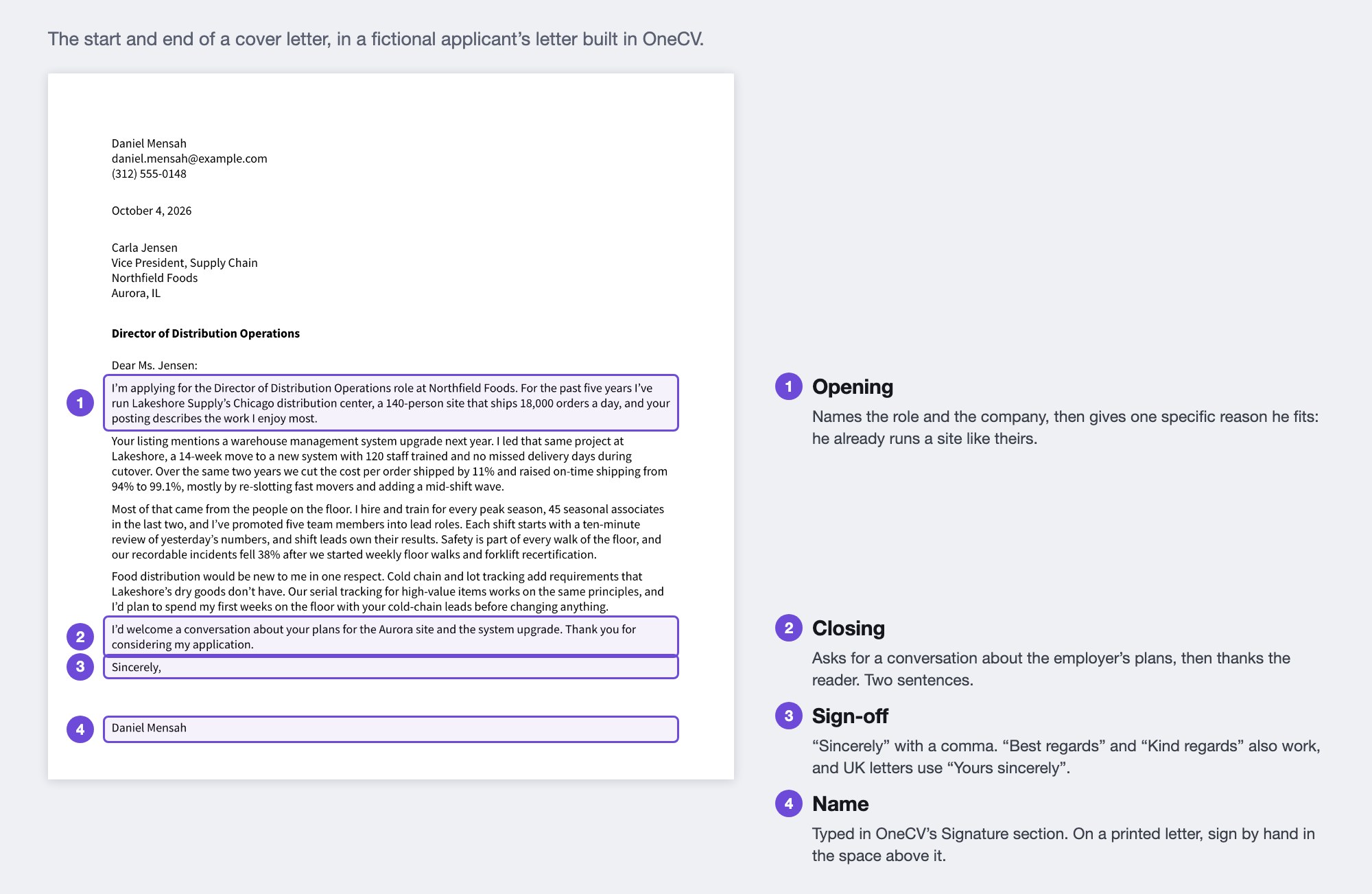
Here's how that looks in a full letter from a fictional operations manager, Daniel, applying to a food distributor.
How should you start a cover letter?
With the job you're applying for and how you heard about it. That's the most common advice across the career offices we read. Prospects, the UK graduate careers site, says to begin "by stating the position you're applying for, where you saw it advertised and when you're available to start". Georgetown's career center says to "mention the specific job title, if you know it, and how you heard about the position opening".
Then give the reader a reason to keep going. Duke's career center says that "interesting and compelling information about your candidacy should be introduced in your first paragraph. The final paragraph is too late." Georgetown suggests ending the opening with a "thesis statement" that guides the reader through the rest of the letter. Penn's career services says that specific, confident claims at the start give the reader "a lot of confidence that your letter and resume are worth reading".
Keep it short. Yale's career office says the introductory and closing paragraphs "should be between one and three sentences".
Not every office wants the job source in the letter. A career guide from GWU's school of public policy says to "refrain from including information about where you found the vacancy announcement". If the source adds nothing, such as a large job board, leave it out and use the space for your reason to fit.
Cover letter opening examples
Here are four openings for Daniel's letter, each for a different situation.
Opening for a job posting
This is the opening in the letter above. It names the role and the company, then gives one fact that matches the job.
I'm applying for the Director of Distribution Operations role at Northfield Foods. For the past five years I've run Lakeshore Supply's Chicago distribution center, a 140-person site that ships 18,000 orders a day, and your posting describes the work I enjoy most.
Opening with a referral
The referrer's name goes in the first sentence.
Priya Shah, your inbound operations manager, suggested I write to you about the Director of Distribution Operations role. We worked together at Lakeshore Supply, where I now run the Chicago distribution center.
Opening with a result
Use this when one number says more than your job title.
In the past two years my team at Lakeshore Supply cut the cost per order shipped by 11% and moved 120 staff onto a new warehouse management system without missing a delivery day. I'd like to bring that experience to Northfield Foods as your Director of Distribution Operations.
Opening for a UK application
UK careers services add the job's reference number and when you can start, as Prospects and the National Careers Service suggest.
I'm applying for the Operations Manager post (reference OPS-2291) advertised on your website. I've run a 140-person distribution centre for five years, and I'm available to start in January.
Is "I am writing to apply for" a bad way to start?
It's the most disputed first line in cover letter advice. A 2026 guest post on Harvard's career blog, written by the job site WayUp, says to skip "I am writing to express my interest in…" because it "signals nothing". Yet the sample letters on Harvard's own cover letter guidance open with "I am writing to express my interest in the Associate position" and "I am writing to apply for the position in wine wholesale", and an example letter on MIT's career site uses the same "writing to apply" opening.
Alison Green of the advice column Ask a Manager recommends an equally plain start, such as "I'm excited to apply for your X position", followed straight away by why you'd be great at the job.
So the sentence after the first one matters more. "I'm applying for" works when the next sentence gives the reader something specific about you. It turns into filler when the whole first paragraph only repeats the job title.
What should you avoid in the first lines?
- Don't open with "My name is…". Your name is already at the top of the page. Ask a Manager says the line "makes you sound young", and Princeton's career center also advises against introducing yourself by name.
- Avoid a fill-in-the-blanks opening. Princeton's cover letter guide warns against openings like "I am a _____ major applying for ____ position with ____ company."
- Don't start every sentence or paragraph with "I". UNC, Michigan and Cambridge all warn against it. Cambridge's careers service says it "has a dull, hypnotic effect, and it gives a selfish impression".
- Skip "To Whom It May Concern" as a greeting. MIT's career office calls it "impersonal". Our cover letter format guide covers the greetings to use instead.
How do you mention a referral in a cover letter?
Name the person in your first sentence, but only with their permission. Michigan's career center says to include a referrer's name "in the first sentence", and GWU's guide adds that "you MUST ask their permission prior to including this".
Make sure the reader thinks well of them, too. Purdue's writing lab says to "make certain that your reader has a positive relationship with the person" before you use their name.
If you met someone from the company at a career fair or an information session, mention that instead. UNC's career center gives an example opening that recalls a conversation with a named employee at a networking night.
How should you end a cover letter?
Restate your interest, ask for an interview or a conversation, and thank the reader, in one to three sentences. Prospects says to "reiterate your interest in the role and indicate your desire for an interview", and Harvard's guidance ends with "thanking the reader for their consideration of your application".
You don't need to repeat your phone number and email. MIT's career office says there's "no need to add contact information here in the closing paragraph" because it's already in your header, your resume or the application. Princeton and Duke suggest adding contact details only if they aren't already on the page.
In the UK, the closing paragraph is also where interview availability goes. Prospects says "now is the time to mention any dates when you're unavailable", and Cambridge's careers service says the same about interview dates. Don't go as far as proposing interview dates yourself. The job site SEEK warns that this "might make you seem inflexible".
Advice on promising a follow-up call is split. Georgetown suggests saying you'll follow up within about two weeks, unless the employer has asked candidates not to get in touch. The staffing firm Robert Half advises against it: "Politely request an interview; don't demand one or say you'll call the office in the coming week." If the posting gives a timeline or asks you not to call, follow that.
Is "I look forward to hearing from you" OK?
In the UK, yes. In the US, career advisers often call it too passive. The National Careers Service says to "tell them you're looking forward to hearing from them", and Newcastle University's careers service calls "Thank you for taking the time to consider my application. I look forward to hearing from you" "a good example".
US advice leans the other way. Northwestern's Kellogg School tells its alumni to avoid the line and to request a meeting, conversation or interview instead, and Robert Half says it "won't spur a manager to pick up the phone".
In practice the gap is small. A closing that asks for a conversation and then says you look forward to hearing from them works in either country. Cambridge's careers service describes these polite closing lines as "not bad, but nor is it strictly necessary".
Cover letter closing examples
Closing for a US letter
This is the end of Daniel's letter.
I'd welcome a conversation about your plans for the Aurora site and the system upgrade. Thank you for considering my application.
Closing for a UK letter
It adds interview availability, as UK careers services suggest.
Thank you for considering my application. I'm available for interview any day except 14 to 18 November, and I look forward to hearing from you.
Closing for a letter in an email
When the letter is the email itself, the closing can point to the attachment.
My resume is attached, and I'd be glad to talk about the role at a time that suits you. Thank you for your time.
Which sign-off should you use on a cover letter?
"Sincerely" is the safe choice in the US, and "Yours sincerely" in the UK when you've addressed the reader by name. "Best regards" and "Kind regards" appear on most career offices' lists as well.
| Sign-off | When to use it |
|---|---|
| Sincerely, | The standard for US letters, listed by Yale, Oregon State, UT Dallas and UNLV |
| Best regards, or Kind regards, | Slightly less formal, and accepted in the US and the UK |
| Yours sincerely, | UK letters to a named person |
| Yours faithfully, | UK letters that start "Dear Sir or Madam" |
| Thank you for your consideration, | A polite alternative that Robert Half lists |
| Cheers, Yours, Take care, Thanks | Too casual. Robert Half, UNLV and Youth Employment UK all name these |
Capitalize only the first word and put a comma after it. Purdue's business letter guide gives "Thank you" as its example of capitalizing the first word only. The UK rule for "Yours sincerely" and "Yours faithfully" is covered in our cover letter format guide.
Do you need to sign a cover letter?
Only on paper. For an online application, type your name under the sign-off. UNC's career center says "an electronic signature is not expected", and Georgetown says you don't need a signature when you apply online. Cambridge's careers service says that without an e-signature, you can "just leave a line break between your closing formula and your printed name".
For a printed letter, leave about four blank lines under the sign-off and sign in ink above your typed name, as Purdue's writing lab and Yale both advise. If you want a signature on a PDF anyway, Duke's career center notes that you can scan your signature and insert the image.
How to write the start and end of a letter in OneCV
In OneCV's cover letter builder, the greeting, the opening and closing paragraphs and the sign-off all go in the Body section on the Write tab. Your name goes in the Signature section below it.
- In the Signature section, type your full name. Create / Upload lets you draw a signature or upload an image of one, and you can add a place and a date under your name. Copy from resume brings in the signature, name, place and date from one of your resumes.
- In the Design tab, the Layout card sets the Declaration position, left or right, and Show declaration line adds a line to sign on. The Font card has a Bold declaration name option.
- OneCV leaves space between the sign-off and your name, as in Daniel's letter, so a printed copy has room for a handwritten signature.
The Free plan includes one cover letter alongside one resume, with all 70 letter templates and unlimited PDF downloads with no watermark. For the paragraphs in between, see our guide to writing a cover letter with no experience, and for how much to write overall, our guide to cover letter length.
Frequently asked questions
How long should the opening paragraph of a cover letter be?
One to three sentences. Yale's career office gives that range for both the opening and the closing paragraph. Daniel's opening is two sentences.
Should I say where I saw the job?
Usually. Prospects, the National Careers Service and Georgetown all suggest it. GWU's guide says to leave it out, so drop it if it takes space from your reason to fit.
Is "Best regards" too casual for a cover letter?
No. Yale, Oregon State, UT Dallas and UNLV all list "Best regards" alongside "Sincerely".
Can I end a cover letter with "Thank you"?
Yes. Robert Half lists "Thank you for your consideration" as a professional closing, and UNC and Harvard both say to thank the reader in the last paragraph.
Should I mention my availability for an interview?
In the UK, yes, especially any dates you can't make. Prospects and Cambridge both suggest it. In the US it's less expected, and SEEK warns against proposing interview dates yourself.
Should the closing paragraph include my phone number?
Only if it isn't already on the page. MIT says there's no need when your contact details are in the header, and Princeton and Duke suggest adding them only if they're missing.
Create your free OneCV account and write a cover letter that opens and closes well.