 Bisrat Shibeshi

A career change cover letter does the job your resume can't. It says why you're applying for work your job history doesn't obviously fit, and how your experience carries over. Name the job and the change in the first paragraph, back up one or two of the posting's needs with results from your old work, show what you've done to prepare, and give a short, positive reason for the switch.
| Part | What it does in a career change letter |
|---|---|
| Opening | Names the job and says you're moving into the field |
| Transferable result | Answers one need from the posting with a result from your old work |
| Proof of commitment | A course, project or volunteer work in the new field |
| Why the change | One or two positive sentences on what draws you to the work |
| Closing | Asks for a conversation and thanks the reader |
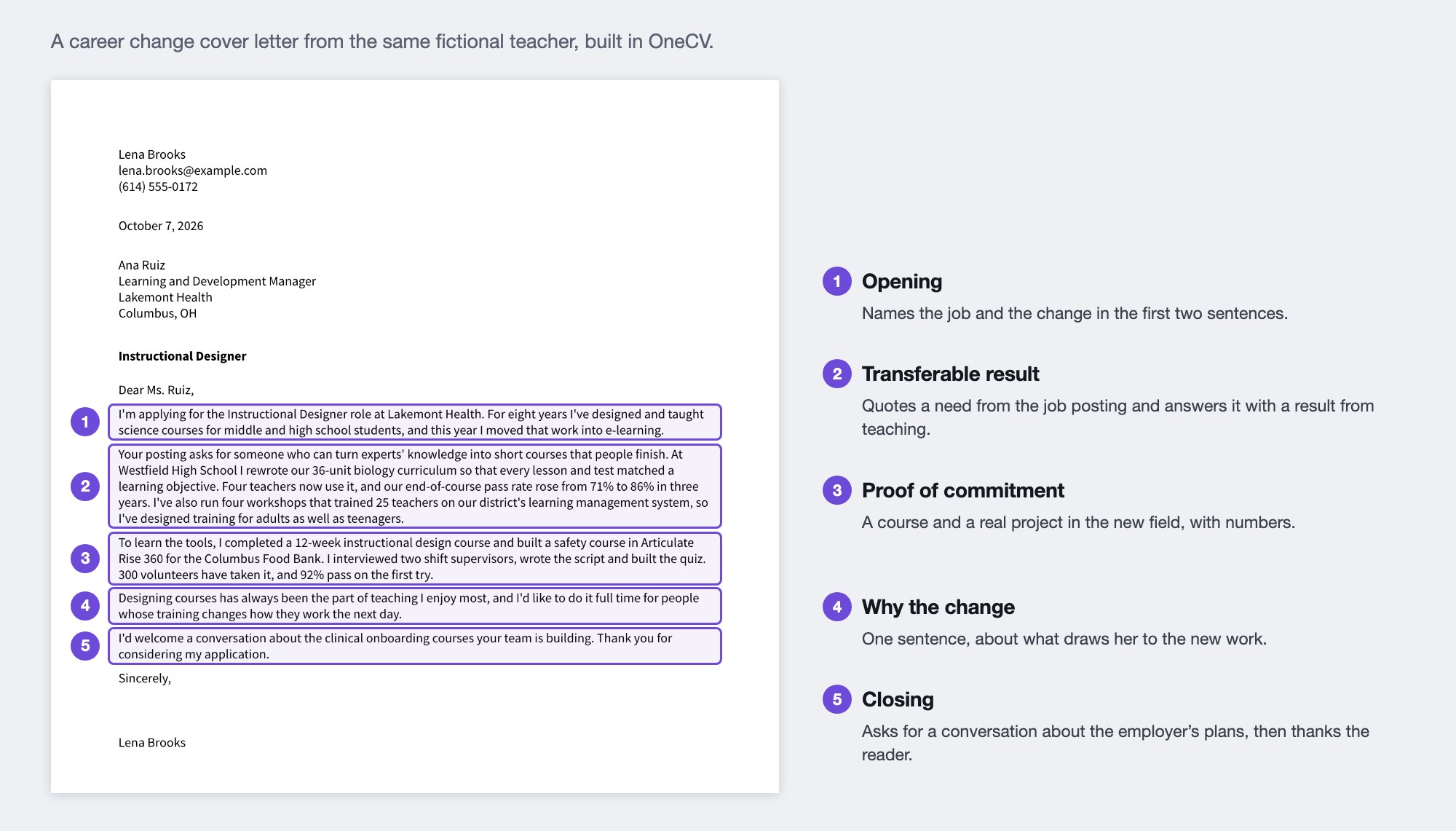
Here's how that looks in a letter from Lena Brooks, the fictional science teacher from our career change resume guide, applying for an instructional design job.
Do you need to mention a career change in your cover letter?
Yes. Asked whether to mention a switch of fields, Alison Green of Ask a Manager answered, "God, yes. Otherwise they'll have no idea why you're applying for a position that doesn't relate to the work they see on your resume." In another answer she says to be explicit about the move "so it doesn't just look like you're applying for everything you see".
It can decide whether you get an interview at all. In 2025 Green published a letter from a reader who moved from libraries into youth work. The reader said their new supervisor told them "without my cover letter, they never would have considered me".
That's also why a career changer should send a letter even when it's optional. Writing about nonprofit jobs, where letters carry a lot of weight, Green adds that "that's especially true if you're trying to change fields, because they'll want to know why you're applying with them in particular".
How to open a career change cover letter
Name the job, then the change. Amherst College's career center says to "briefly name the pivot and then frame it as a strength". Robert Half, the staffing firm, says the opening "can be simple and straightforward, and doesn't need to differ too much from a standard cover letter".
You can say it outright or let it show. A career guide from the University of Northwestern–St. Paul says "a recruiter will notice that you are changing careers, so you should address it. You can do this explicitly or more subtly." Here are three openings for Lena's letter.
Explicit opening
This is the opening in the letter above.
I'm applying for the Instructional Designer role at Lakemont Health. For eight years I've designed and taught science courses for middle and high school students, and this year I moved that work into e-learning.
Subtle opening
This one leads with the skill and lets the reader see the change from her resume.
I'm applying for the Instructional Designer role at Lakemont Health. I've spent eight years designing courses and tests around clear learning objectives, most recently a safety course that 300 food bank volunteers now take before their first shift.
Opening with a contact
If you've talked to someone at the company, name them. Robert Half says that mentioning a contact by name "helps personalise the letter and shows you already have industry contacts".
Sam Okafor on your learning team suggested I apply for the Instructional Designer role after we talked about how Lakemont builds its clinical training. I'm a science teacher moving into instructional design, and I've spent this year building e-learning courses.
Prospects, the UK graduate careers site, goes further and suggests you "begin with a statement about why you want to change career". That works too, as long as it's short. Our guide to starting and ending a cover letter has more openings.
How to explain why you're changing careers
Briefly, and in terms of what draws you to the new work. Prospects says to "keep it brief - you can go into more detail about this if invited for interview". Robert Half says to "keep this explanation positive, and avoid any unprofessional references to past employers, colleagues or clients". Green puts it this way: "A cover letter is for explaining why you'd be great at the job you're applying for, not for explaining what you don't like about the job you're leaving."
Lena gives her reason in one sentence. Designing courses was the part of teaching she enjoyed most, and she'd like to do it full time. It says nothing about what's wrong with teaching.
Honesty about values is different from complaining. One letter Green published as a good example came from someone returning to archaeology after years in another industry. It says plainly that its writer had once been "unhappy with what I felt was the prioritization of the needs of industry over all other concerns", covers that in a couple of sentences and moves on. The writer got the job.
Personal reasons rarely belong. Green makes one exception for nonprofits, where a few sentences on how your own experience connects you to the organization's mission can help. Even then, she says, the focus should stay on why you'd excel at the job.
How to show your skills carry over
Pick one or two needs from the posting and answer each with a result. Harvard's career office says to point out relevant experience "with one or two key examples; but do not reiterate your entire resume". Amherst says to "use 1–2 specific examples that show how you've made an impact".
Lena's second paragraph opens with the posting's own words, "turn experts' knowledge into short courses that people finish", and answers with her curriculum and the pass rate it produced. A training manager doesn't need to know anything about schools to understand a rise from 71% to 86%.
Use the employer's words for your experience. Penn's career office suggests "describing your experience in the employer's language (using some of their keywords), not your own". The Northwestern–St. Paul guide says to "use the same keywords from the job description".
Spell the connection out. Writing about a lawyer trying to leave law, Green says "you can't assume they'll figure it out for themselves". If writing the paragraph is hard, she suggests you "imagine you're writing an email to a friend about why you think you'd be really good at this job".
Don't apologize for missing experience
The reader can see what you lack. Indiana University Indianapolis's Luddy School says not to apologize for shortcomings, such as "Although I don't have the required experience". Excelsior University says "instead of drawing attention to your weaknesses, emphasize the strengths and transferable skills you do have." Green says employers are "going to figure it out themselves".
"Although" is fine when the sentence turns straight to a strength. Amherst's own example begins "Although my academic background is in biology" and goes on to what the writer learned at a nonprofit.
Overclaiming backfires too. In a before and after letter Green published, the first draft told the employer "I believe I more than meet the required qualifications for the role". Its writer later said, "I'm a little embarrassed at how arrogant it was."
How to show you're serious about the new field
Show what you've already done. Prospects says that if you have qualifications that are relevant to the new career, "be sure to mention these". The University of Michigan alumni association's career change guide asks, "Have you done any upskilling (e.g., learned a new language, completed a technical course)?"
A project is stronger than a course alone, because it's work in the new field. Lena's third paragraph gives both, a 12-week course and a food bank safety course that 300 volunteers have taken.
You can mention training that isn't finished. One of Harvard's sample letters, from someone moving into wine sales, says "I am in the process of acquiring certification" from two wine bodies.
Should you mention a pay cut or a step down?
Sometimes. If you're applying for work below your current level, Green says your resume "needs to be accompanied by a cover letter that explains your interest". Otherwise, she writes, "people will tend to assume that you secretly do" still want the more senior jobs.
If employers seem to assume they can't afford you, Green suggests a line in the part of the letter about why you're changing fields, such as "I'm prepared for the pay cut that I expect changing fields will entail." That acknowledges what the new field pays. Offering to work for less is different, and she advises against it: "they (hopefully) want the best person for the job, not the cheapest."
How long should a career change cover letter be?
One page, like any other cover letter. Robert Half says to "keep your career change cover letter to a single page unless the job posting states otherwise", and Harvard says "no more than a single page". None of the career offices we read says a career change letter should be longer. Lena's letter is about 230 words. Our guide to cover letter length has the details.
Career change cover letter example
Here's Lena's full letter.
Dear Ms. Ruiz,
I'm applying for the Instructional Designer role at Lakemont Health. For eight years I've designed and taught science courses for middle and high school students, and this year I moved that work into e-learning.
Your posting asks for someone who can turn experts' knowledge into short courses that people finish. At Westfield High School I rewrote our 36-unit biology curriculum so that every lesson and test matched a learning objective. Four teachers now use it, and our end-of-course pass rate rose from 71% to 86% in three years. I've also run four workshops that trained 25 teachers on our district's learning management system, so I've designed training for adults as well as teenagers.
To learn the tools, I completed a 12-week instructional design course and built a safety course in Articulate Rise 360 for the Columbus Food Bank. I interviewed two shift supervisors, wrote the script and built the quiz. 300 volunteers have taken it, and 92% pass on the first try.
Designing courses has always been the part of teaching I enjoy most, and I'd like to do it full time for people whose training changes how they work the next day.
I'd welcome a conversation about the clinical onboarding courses your team is building. Thank you for considering my application.
Sincerely,
Lena Brooks
How to write a career change cover letter in OneCV
Lena's letter was built in OneCV's cover letter builder with the Classic Left template on US Letter.
- On the Write tab, Copy from resume fills in your name and contact details from your resume.
- The greeting, paragraphs and sign-off go in the Body section, and your name goes in the Signature section.
- In the Design tab, Copy resume design gives the letter the same fonts, colors and spacing as your resume, so the two match.
The Free plan includes one cover letter alongside one resume, with all 70 letter templates and unlimited PDF downloads with no watermark. On Pro, the AI tools can draft a cover letter for a job posting, written from what your resume says, so put your transferable results and new-field projects in your resume first. For applicants with no work history at all, see our guide to a cover letter with no experience.
Frequently asked questions
Should a career change cover letter explain why I'm leaving my current job?
Briefly. Say what draws you to the new field in a sentence or two and leave your complaints about the old one out. Prospects says you can go into more detail at the interview.
What if I have no experience in the new field?
Lead with results from your current work that answer the posting's needs, then mention any course, project or volunteer work in the new field. Don't apologize for what's missing. The reader can see it on your resume.
Should I mention a course I haven't finished?
Yes, and say it's in progress. One of Harvard's sample letters says "I am in the process of acquiring certification".
Is a cover letter worth sending for a career change if it's optional?
Yes. It's the only place you can explain the switch. Green says employers want to know why a career changer is applying with them in particular, and one of her readers was told they wouldn't have been considered without the letter.
Should I say I'm willing to take a pay cut?
Only if employers seem to assume they can't afford you, and then only to show you know the new field pays less. Don't offer to work for less than the job pays to make up for missing experience. Green advises against that.
Should I name the career change in the first sentence?
In the first paragraph. Name the job first, then the change, as Lena does in her second sentence. Amherst and Northwestern–St. Paul both say to address it early, either outright or by leading with the skill that carries over.
Create your free OneCV account and write a cover letter that explains your career change.