 Bisrat Shibeshi

A career change resume puts the job you want at the top and the evidence for it first. Put the target job title under your name, write a two- or three-sentence summary that says you're moving into the new field, and list your transferable skills and any projects or courses in that field above your job history. Keep your past jobs with their dates, rewrite their bullets in the new field's words, and cut whatever doesn't apply.
| Part of the resume | What changes for a career change |
|---|---|
| Title under your name | The job you're applying for |
| Summary | Two or three sentences that name the new field and what you've done to prepare |
| Skills | The skills the new job asks for, each with a result, above your experience |
| Projects, courses and volunteer work | Any work or training in the new field, paid or unpaid, near the top |
| Job history | Kept with dates, with bullets rewritten in the new field's terms |
| Details from the old field | Cut, or shortened to one line |
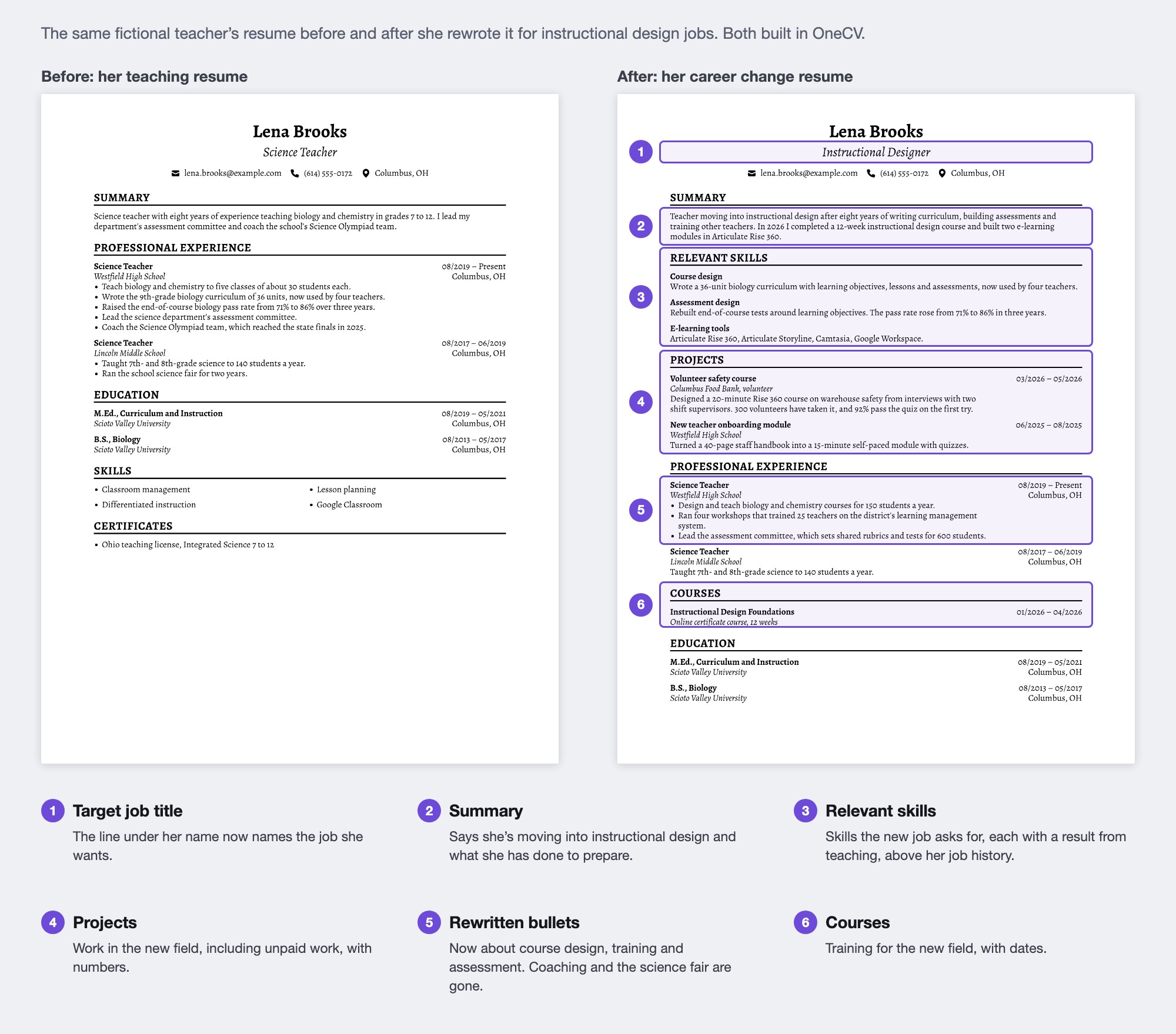
Here's one resume before and after. Lena Brooks, a fictional science teacher, rewrote hers to apply for instructional design jobs, where she'd build training courses for companies.
Put the job you want at the top
Start with the line under your name. Most resumes show your current job title there, and on a career change that tells the reader the wrong thing first. Lena changed hers from Science Teacher to Instructional Designer.
Then add a short summary. Career offices that call a summary optional make an exception for career changers. The University of York's careers service says a profile "is ideal for career changers as it demonstrates skills and qualities gained from your last job that are transferable to the career area you are looking for". Excelsior University's writing lab suggests "a 2–3 sentence summary that connects your past experience to your new goals".
Say plainly that you're changing fields. Harvard Business School Online's blog tells career changers to "be transparent about the transition" in the summary and the cover letter. Lena's summary opens with "Teacher moving into instructional design" and then says what she has done to prepare.
Should you write a summary or an objective?
A summary. Sources split on the top section, but they agree on this much. Wharton's online program says that although the section is often optional, "this section is crucial for those looking to change careers". Alison Green of Ask a Manager says "resume objectives never help and often hurt" because they're about what you want "rather than what the employer wants". Robert Half, the staffing firm, also says to "skip the old-fashioned objective statement".
Green adds that "profile sections or summaries have replaced objectives". So write a summary about what you offer, with the target job in it. "Seeking a role in instructional design" is an objective. "Teacher moving into instructional design after eight years of writing curriculum" is a summary.
Which resume format is best for a career change?
A hybrid, also called a combination resume. It opens with your skills and keeps your job history, with dates, below them. CareerOneStop, the US Department of Labor's careers site, says a straight chronological resume "does not work as well when you are switching careers" and that "a combination of these formats works well for most people". Robert Half calls hybrid "the best resume format for career changers".
A functional resume, which groups everything under skills and drops the dated job history, is the riskier choice. Some career offices still suggest it. Purdue's writing lab says the skills format suits "people who are making a significant change in careers", and York and Prospects suggest a skills-based CV.
Hiring managers are warier. Of functional resumes, Green writes that "the first thing I think when I see them is, 'What is this candidate trying to hide?'" In the same answer she says a chronological resume with a skills summary added at the top is fine, and that's a hybrid. Robert Half says that "hiring managers have long been wary of functional resumes, and today's screening software shares that wariness". CareerOneStop warns that without your employment history, "your resume may be rejected by applicant tracking systems".
Our guide to resume formats shows one person's resume in all three.
How to find your transferable skills
O*NET, the US Department of Labor's occupation database, defines transferable skills as "skills you can use across different jobs, such as communication, problem solving, and team work". The useful ones for your resume are the ones the new job asks for. Four ways to find them:
- List what you do now. CareerOneStop suggests "listing the key tasks from your previous jobs" and looking at the verbs. Lena's list included writing curriculum, building tests, analyzing results and running staff workshops.
- Read several job postings in the new field. Robert Half suggests you "look for repeated language around skills, tools and day-to-day expectations". The postings Lena read kept asking for learning objectives, assessments, e-learning tools and work with subject experts.
- Talk to people who do the job. Prospects quotes a career change coach who says to "talk to people in the field to get a sense of the jargon and phrases they use".
- Try a free matching tool. mySkills myFuture, run by CareerOneStop, takes a job you've held and finds "other careers where workers often use the same skills". Its comparison page shows the skills two careers share and "possible skills and knowledge gaps between the two careers".
How to rewrite your bullets for the new field
Keep the facts and change the words. Robert Half's example is a server applying for office work. In place of "waited tables", they could write that they "kept six tables on track through a full dinner service in a high-volume restaurant". As Robert Half puts it, "you just need to describe it in the employer's language."
Here's how Lena's bullets changed.
| Teaching resume | Career change resume |
|---|---|
| Wrote the 9th-grade biology curriculum of 36 units, now used by four teachers. | Wrote a 36-unit biology curriculum with learning objectives, lessons and assessments, now used by four teachers. |
| Raised the end-of-course biology pass rate from 71% to 86% over three years. | Rebuilt end-of-course tests around learning objectives. The pass rate rose from 71% to 86% in three years. |
| Teach biology and chemistry to five classes of about 30 students each. | Design and teach biology and chemistry courses for 150 students a year. |
| Lead the science department's assessment committee. | Lead the assessment committee, which sets shared rubrics and tests for 600 students. |
| Not listed | Ran four workshops that trained 25 teachers on the district's learning management system. |
The last row matters most. Training adults was a small part of Lena's teaching job, so she'd left it off. For instructional design it's some of her best evidence.
Use the posting's words where they're true. MIT's career office suggests you "match job-specific terminology that you're seeing within the job description". Exact wording can decide whether a person ever reads your resume. In a 2021 Harvard Business School and Accenture survey of more than 2,250 executives, 88% said qualified high-skills candidates were screened out because they "did not match the exact criteria established by the job description". A career change handout from the University of Northwestern–St. Paul adds the limit: use the posting's terms only "while remaining honest about your experiences and skills".
Should you keep the numbers from your old job?
Keep the ones a reader in the new field can judge. Excelsior's guide suggests stressing duties over numbers, because old-field achievements "could fly over the head of hiring managers in your new one". Most other guides push results. Both have a point. A training manager understands a pass rate and a count of people trained, so Lena kept those. A Science Olympiad team reaching the state finals means little outside schools, so she cut it.
Where to put projects, courses and volunteer work
Near the top. Evidence from the new field is what a career changer has least of, so show it before the reader reaches your old job titles. The Northwestern–St. Paul handout warns that the usual order "can cause some of the most relevant experiences to end up on the second page and hidden from the recruiter". About a counselor's new license, it says "Put your license on the top!" Harvard's career office says to list headings "in order of importance for the specific role".
Unpaid work counts. MIT's career office says of volunteer work and personal projects, "It doesn't matter that they weren't paid. You can still include those." Purdue Global says that if you've "earned a certificate, taken applicable courses, or led projects using skills relevant to the new career, showcase them prominently".
Lena put a Projects section above her teaching jobs, with the safety course she built for a food bank and a module she made for new teachers. Her course went just below her jobs.
Another layout splits your jobs in two. MIT describes "a relevant experience category" near the top and an additional experience section further down. Purdue's writing lab suggests a "RELEVANT EXPERIENCE" heading too. This works well when some of your past jobs already touch the new field and others don't.
What to leave out
Cut details that only matter in your old field. HBS Online says that if specialized skills from your current job "aren't relevant to your target role, deprioritize them". Lena dropped her classroom management skills, her teaching license, the Science Olympiad team and the science fair.
Shorten older and unrelated jobs. Purdue Global's career director suggests limiting your history "to the most recent 10 years unless experience beyond that speaks directly to your desired position". Wharton goes further: "Stick to your most recent two or three jobs, and leave older, irrelevant jobs behind."
Don't delete your work history, though. LSE's careers service says "it's still important that you include your work history. Gaps can raise questions". Lena kept her middle school job as a single line, so her dates run unbroken from 2017.
How common are career changes?
Common enough that nobody has an official count. The claim that people change careers five to seven times has no government source behind it. The US Bureau of Labor Statistics says it "never has attempted to estimate the number of times people change careers in the course of their working lives", because "no consensus has emerged on what constitutes a career change".
BLS does count jobs, meaning stints with one employer. People born from 1957 to 1964 held an average of 12.9 jobs from ages 18 to 58, and people born in the early 1980s held 9.4 jobs from 18 through 38.
Many of those moves cross fields. The Pew Research Center found that "roughly half (49.5%) of workers who changed employers also changed occupations" in an average month from 2019 to 2021. In the UK, the Office for National Statistics found that 5.6% of workers moved to a different occupation group within a year.
How to make a career change resume in OneCV
Lena's resumes were built in OneCV's resume builder with the Classic Clear template on US Letter.
- In Personal details, type the job you want in the Professional title field. Its hint reads "Target position or current role".
- Use Add Content to add a Summary, Projects, Courses, Organisations for volunteer work, or a Custom section. Lena's Relevant Skills is a Custom section with one entry per skill.
- Open any section and click Edit Heading to rename it. You could rename Professional Experience to Relevant Experience and add a Custom section called Additional Experience for MIT's two-part layout.
- In the Customize tab, use Change Section Layout in the Layout card to drag your skills and projects above your experience.
The Free plan includes one resume and one cover letter, all 105 templates and unlimited PDF downloads with no watermark. To keep your old resume next to the new one, Pro has unlimited resumes. If your current resume is a PDF, Import resume brings its text in so you can rewrite it instead of retyping.
Your cover letter is where you explain the change. Our guide to writing a career change cover letter uses Lena's letter as its example.
Frequently asked questions
Should I use a functional resume for a career change?
Usually not. A hybrid gives you the same skills-first opening and keeps the dated job history that hiring managers and applicant tracking systems look for. Ask a Manager and Robert Half both say hiring managers distrust resumes without one.
How do I write a career change resume with no experience in the new field?
Lead with transferable skills backed by results from your current work, then add any course, project or volunteer work in the new field. MIT's career office says unpaid projects count. If you don't have one yet, a small project like Lena's food bank course is the fastest way to get one.
Should I list jobs that have nothing to do with the new career?
Yes, briefly. Keep each with its title, employer and dates so your history has no gaps, and cut its bullets to one line or none. LSE's careers service warns that gaps "can raise questions".
Should my resume say I'm changing careers?
Yes, in the summary. HBS Online advises being transparent about the transition. Keep it to a few words on the resume and give the reasons in your cover letter.
How far back should a career change resume go?
About 10 to 15 years. Purdue Global's career director suggests 10 unless older work relates directly to the new job, and San José State's School of Information says the last 10 to 15 years can count as relevant experience.
How long should a career change resume be?
One page is often enough, because jobs from your old field shrink to a few lines each. Lena's fits on one US Letter page with six sections. Our guide to resume length covers when a second page makes sense.
Create your free OneCV account and rebuild your resume around the job you want.